

The information here may change before this webpage can be updated. Please consult your parish priest or other trusted resources to ensure the information is current.
Lent
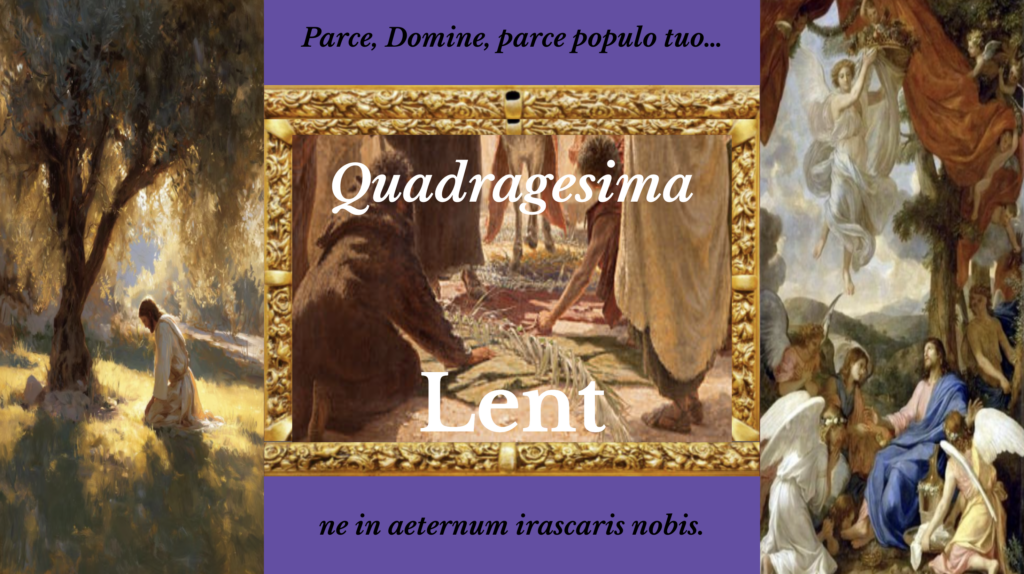
Lent is a solemn forty-day season marked by prayer, fasting, and almsgiving to prepare for Easter when the Church unites herself to the mystery of Jesus in the desert.
Name in Traditional Liturgy: Quadragesima (The Forty Days)
Season Preceding Lent: Ordinary Time
Commences: Ash Wednesday (46 Days before Easter Sunday)
Ends: Lent officially concludes on the evening of Holy Thursday right before the Mass of the Lord’s Supper begins. This leads into the Sacred Triduum, marking the end of the 40-day Lenten season.
The Catechism and Lent:
540 Jesus’ temptation reveals the way in which the Son of God is Messiah, contrary to the way Satan proposes to him and the way men wish to attribute to him (see Mt 16:21-23).
1095 For this reason the Church, especially during Advent and Lent and above all at the Easter Vigil, re-reads and re-lives the great events of salvation history in the “today” of her liturgy. But this also demands that catechesis help the faithful to open themselves to this spiritual understanding of the economy of salvation as the Church’s liturgy reveals it and enables us to live it.
1438 The seasons and days of penance in the course of the liturgical year (Lent, and each Friday in memory of the death of the Lord) are intense moments of the Church’s penitential practice. 36 These times are particularly appropriate for spiritual exercises, penitential liturgies, pilgrimages as signs of penance, voluntary self-denial such as fasting and almsgiving, and fraternal sharing (charitable and missionary works).
Lenten Fasting and Abstinence
Fasting Population: Adults from age 18 until the beginning of their 60th birthday (age 59).
Abstinence Population: Catholics aged 14 and older.
Rule of Abstinence: Refrain from eating meat (beef, pork, chicken, etc.). Fish and dairy products are permitted.
Exempted Population: People with physical or mental illnesses or chronic conditions.
Women who are with child (pregnant) or nursing are excused from these physical fasts and penances.
Code of Canon Law: Days of Penance
Can. 1249 The divine law binds all the Christian faithful to do penance each in his or her own way. In order for all to be united among themselves by some common observance of penance, however, penitential days are prescribed on which the Christian faithful devote themselves in a special way to prayer, perform works of piety and charity, and deny themselves by fulfilling their own obligations more faithfully and especially by observing fast and abstinence, according to the norm of the following canons.
Can. 1250 The penitential days and times in the universal Church are every Friday of the whole year and the season of Lent.
Can. 1251 Abstinence from meat, or from some other food as determined by the Episcopal Conference, is to be observed on all Fridays, unless a solemnity should fall on a Friday. Abstinence and fasting are to be observed on Ash Wednesday and Good Friday.
Can. 1252 The law of abstinence binds those who have completed their fourteenth year. The law of fasting binds those who have attained their majority, until the beginning of their sixtieth year. Pastors of souls and parents are to ensure that even those who by reason of their age are not bound by the law of fasting and abstinence, are taught the true meaning of penance.
Can. 1253 The conference of bishops can determine more precisely the observance of fast and abstinence as well as substitute other forms of penance, especially works of charity and exercises of piety, in whole or in part, for abstinence and fast.
Ash Wednesday
Ash Wednesday is the doorway into our Lenten season of renewal – a day rich in associations and symbolism. It marks the beginning of Lent – a time for turning again to the practice of our faith, in prayer, self-denial (fasting) and practical generosity (almsgiving).
Name in Traditional Liturgy: Feria quarta cinerum (Wednesday of the ashes), or simply Dies cinerum (Day of Ashes)
Liturgical Color: Violet (symbolizes penance, sacrifice, and purification as the Church enters the solemn season of Lent).
Type of Liturgical Day: High Precedence (Tabula dierum liturgicorum secundum ordinem praecedentiae textum, Tabula Praecedentiae, Tabula Dierum Liturgicorum):
Season Preceding Ash Wednesday: Ordinary Time
Commences: 46 Days before Easter Sunday
Ends: Dies liturgicus (the liturgical day), Decurrit a media nocte ad mediam noctem (runs from midnight to midnight.
Office: In the Roman Catholic Liturgy of the Hours, Ash Wednesday initiates the Lenten season (often designated as Week 0 of Lent) and features distinct, proper texts with a proper (specific) office within the Liturgy of the Hours (Divine Office), rather than using the standard weekday psalter for that day. Specific psalms, canticles, and penitential antiphons (such as Psalm 51) are assigned specifically for Ash Wednesday’s Morning, Midday, and Evening prayers to emphasize penance and conversion. General instruction dictates that a votive office cannot be celebrated on Ash Wednesday, safeguarding the unique penitential character of the liturgy.
Ash Wednesday and the Catechism: “Abstinence from meat, or from some other food as determined by the Episcopal Conference, is to be observed on all Fridays, unless a solemnity should fall on a Friday. Abstinence and fasting are to be observed on Ash Wednesday and Good Friday. “ Canon 1251
Receiving Ashes: An outward sign of an inner step: Along with reminding us of our mortality, the ashes on Ash Wednesday are also symbolic of grief; grief from the sins we have committed. We may not always be able to resist temptation as Jesus did, but Lent provides an opportunity to reflect, pray and repent for our sins. In doing so, many people make sacrifices or commit to life changes throughout the 40 days of lent. It is a time for spiritual fasting so we may cleanse our souls and renew our faith as we prepare for the resurrection of Jesus on Easter Sunday.
“As we cross this threshold we customarily receive ashes on our foreheads, in the sign of the cross. This is a public mark of our turning again to God, seeking his mercy, forgiveness and help.
“We use these words: ‘Remember that you are dust, and to dust you shall return’. Yes, we cannot pretend otherwise. Or: ‘Repent, and believe in the Gospel’. Yes, we seek the one thing that is absolutely necessary: the grace of God.”
Ashes in the Bible:
“Therefore I disown what I have said, and repent in dust and ashes.” (Job 42:6)
“Daughter of my people, dress in sackcloth, roll in the ashes.” (Jeremiah 6:26)
“I turned to the Lord God, to seek help, in prayer and petition, with fasting, sackcloth, and ashes.” (Daniel 9:3)
“When the news reached the king of Nineveh, he rose from his throne, laid aside his robe, covered himself with sackcloth, and sat in ashes. Then he had this proclaimed throughout Nineveh: “By decree of the king and his nobles, no man or beast, no cattle or sheep, shall taste anything; they shall not eat, nor shall they drink water. Man and beast alike must be covered with sackcloth and call loudly to God; they all must turn from their evil way and from the violence of their hands.” (Jonah 3: 6-8)
Holy Thursday
The central observance of Holy Thursday is the ritual reenactment of the Last Supper at Mass. Holy Thursday consists of the Chrism Mass, The Mass of the Lord’s Supper, The Washing of the Feet (establishment of the priesthood reenacted at Mass with the priest washing the feet of several parishioners), Transfer of the Eucharist (a solemn liturgical procession where the Blessed Sacrament is moved from the main altar to a temporary place of reservation called the Altar of Repose), the Adoration of the Blessed Sacrament (the faithful remain in the presence of the Eucharist just as the Disciples kept a vigil with Christ), and the Stripping of the Altar (a solemn rite performed after the Mass of the Lord’s Supper on Holy Thursday, where all cloths, candles, and ornaments are removed to leave the altar completely bare representing Jesus being stripped of his garments by soldiers before his crucifixion and mirroring the abandonment by the disciples in Gethsemane and the stark sorrow leading into Good Friday).
Type of Liturgical Day: High Precedence (Tabula Praecedentiae, Tabula Dierum Liturgicorum)
Season Preceding Holy Thursday: Lent
Commences: The Evening Mass of the Lord’s Supper
Ends: Dies liturgicus (the liturgical day), Decurrit a media nocte ad mediam noctem (runs from midnight to midnight.
Name in Traditional Liturgy: Feria quinta in Cena Domini
Latin Derivative: Feria quinta means “Thursday of the fifth day [of the week],” and in Cena Domini specifically references the Last Supper.
Liturgical Color: White
Mass: Final Blessing and Formal Dismissal Omitted
Of Holy Thursday: Chrism Mass, The Foot Washing (Mandatum), Transfer of the Eucharist to the Altar of Repose, Adoration of the Blessed Sacrament, and The Stripping of the Altar (Denudatio Altaris)
The Chrism Mass: Often held earlier in the day at the cathedral, the bishop blesses sacred oils used throughout the year for sacraments.
Mass of the Lord’s Supper: Celebrated in the evening, this service features the symbolic foot-washing ritual performed by the priest.
Altar of Repose: After communion, the remaining consecrated hosts are moved to a temporary altar. The faithful stay late into the night in quiet prayer, mirroring Jesus’ agony in the Garden of Gethsemane.
Office: Psalter Week II
Holy Thursday and the Catechism:
1324 The Eucharist is “the source and summit of the Christian life.” 136 “The other sacraments, and indeed all ecclesiastical ministries and works of the apostolate, are bound up with the Eucharist and are oriented toward it. For in the blessed Eucharist is contained the whole spiritual good of the Church, namely Christ himself, our Pasch.” 137
1337 The Lord, having loved those who were his own, loved them to the end. Knowing that the hour had come to leave this world and return to the Father, in the course of a meal he washed their feet and gave them the commandment of love. 163 In order to leave them a pledge of this love, in order never to depart from his own and to make them sharers in his Passover, he instituted the Eucharist as the memorial of his death and Resurrection, and commanded his apostles to celebrate it until his return; “thereby he constituted them priests of the New Testament.” 164
1340 By celebrating the Last Supper with his apostles in the course of the Passover meal, Jesus gave the Jewish Passover its definitive meaning. Jesus’ passing over to his father by his death and Resurrection, the new Passover, is anticipated in the Supper and celebrated in the Eucharist, which fulfills the Jewish Passover and anticipates the final Passover of the Church in the glory of the kingdom.
1566 “It is in the Eucharistic cult or in the Eucharistic assembly of the faithful (synaxis) that they exercise in a supreme degree their sacred office; there, acting in the person of Christ and proclaiming his mystery, they unite the votive offerings of the faithful to the sacrifice of Christ their head, and in the sacrifice of the Mass they make present again and apply, until the coming of the Lord, the unique sacrifice of the New Testament, that namely of Christ offering himself once for all a spotless victim to the Father.” 49 From this unique sacrifice their whole priestly ministry draws its strength. 50
1356 If from the beginning Christians have celebrated the Eucharist and in a form whose substance has not changed despite the great diversity of times and liturgies, it is because we know ourselves to be bound by the command the Lord gave on the eve of his Passion: “Do this in remembrance of me.” 183
1168 Beginning with the Easter Triduum as its source of light, the new age of the Resurrection fills the whole liturgical year with its brilliance. Gradually, on either side of this source, the year is transfigured by the liturgy. It really is a “year of the Lord’s favor.” 42 The economy of salvation is at work within the framework of time, but since its fulfillment in the Passover of Jesus and the outpouring of the Holy Spirit, the culmination of history is anticipated “as a foretaste,” and the kingdom of God enters into our time.
The Structure of Lent
Ash Wednesday
Type of Liturgical Day: High Precedence (Tabula Praecedentiae, Tabula Dierum Liturgicorum)
Name in Traditional Liturgy: Feria quarta cinerum (Wednesday of the ashes), or simply Dies cinerum (Day of Ashes)
Color: Violet (symbolizes penance, sacrifice, and purification as the Church enters the solemn season of Lent).
Mass: Penitential Act Omitted
Office: Wednesday of Week IV (4) of the four-week psalter
Commences: 46 Days before Easter Sunday
Ends: Dies liturgicus (the liturgical day), Decurrit a media nocte ad mediam noctem (runs from midnight to midnight.
First Sunday of Lent
Type of Liturgical Day: High Precedence (Tabula Praecedentiae, Tabula Dierum Liturgicorum)
Name in Traditional Liturgy: Quadragesima Sunday or Invocabit Sunday
Quadragesima Sunday: Latin for “Sunday in the fortieth,” reflecting the roughly 40-day period of Lent.
Invocabit Sunday: Named from the traditional Latin opening antiphon (Introit) for the day, Invocabit ad me (“He will call upon me”), derived from Psalm 91:15.
Color: Purple
Mass: Gloria Omitted
Office: Psalter Week I
Ends: Dies liturgicus (the liturgical day), Decurrit a media nocte ad mediam noctem (runs from midnight to midnight.
Second Sunday of Lent
Type of Liturgical Day: High Precedence (Tabula Praecedentiae, Tabula Dierum Liturgicorum)
Name in Traditional Liturgy: Reminiscere Sunday
Latin: From the first word of the traditional Latin Introit (entrance psalm) for the day, which begins with Psalm 25:6: “Reminiscere miserationum tuarum, Domine” (“Remember your mercy, O Lord”).
Color: Purple
Mass: Gloria Omitted
Office: Psalter Week II
Ends: Dies liturgicus (the liturgical day), Decurrit a media nocte ad mediam noctem (runs from midnight to midnight.
Third Sunday of Lent
Type of Liturgical Day: High Precedence (Tabula Praecedentiae, Tabula Dierum Liturgicorum)
Name in Traditional Liturgy: Oculi Sunday
Latin: From the Latin opening word of the Introit (entrance antiphon) for that day’s Mass, “Oculi mei semper ad Dominum” (“My eyes are ever toward the Lord”) from Psalm 24:15.
Color: Purple
Mass: Gloria Omitted
Office: Psalter Week III
Ends: Dies liturgicus (the liturgical day), Decurrit a media nocte ad mediam noctem (runs from midnight to midnight.
Fourth Sunday of Lent
Type of Liturgical Day: High Precedence (Tabula Praecedentiae, Tabula Dierum Liturgicorum)
Name in Traditional Liturgy: Laetare Sunday
Latin: Laetare means “rejoice”. The day offers a brief pause from penance to look forward to Easter. It marks the halfway point of the Lenten season.
Color: Purple (or Rose)
Mass: Gloria Omitted
Office: Psalter Week IV
Ends: Dies liturgicus (the liturgical day), Decurrit a media nocte ad mediam noctem (runs from midnight to midnight.
Fifth Sunday of Lent: Passion Sunday, Palm Sunday
Type of Liturgical Day: High Precedence (Tabula Praecedentiae, Tabula Dierum Liturgicorum)
Name in Traditional Liturgy: Dominica in Ramis Palmarum (or Dominica Palmarum or Dominica in Palmis de Passione Domini)
Latin: From the literal translation for “Sunday of the Palm Branches.” It marks the start of a two-week period before Easter known as Passiontide.
Color: Red
Mass: No Penitential Rite after Procession or Solemn Entrance, Gloria Omitted
Office: Psalter Week II
Ends: Dies liturgicus (the liturgical day), Decurrit a media nocte ad mediam noctem (runs from midnight to midnight.
Holy Thursday
Type of Liturgical Day: High Precedence (Tabula Praecedentiae, Tabula Dierum Liturgicorum)
Name in Traditional Liturgy: Feria quinta in Cena Domini
Latin: Feria quinta means “Thursday of the fifth day [of the week],” and in Cena Domini specifically references the Last Supper.
Color: White
Mass: Final Blessing and Formal Dismissal Omitted
Office: Psalter Week II
Ends: Dies liturgicus (the liturgical day), Decurrit a media nocte ad mediam noctem (runs from midnight to midnight.
Chrism Mass (Holy Thursday)
Type of Liturgical Day: High Precedence (Tabula Praecedentiae, Tabula Dierum Liturgicorum)
Name in Traditional Liturgy: In the traditional liturgy of the Roman Rite (prior to the 1955 reform of Holy Week), a separate “Chrism Mass” as an independent standalone mass did not have its own distinct proper name; instead, the blessing of the oils took place during the morning Mass of Holy Thursday, known in Latin as Feria Quinta in Cena Domini (“Thursday of the Supper of the Lord”).
Color: White
Mass: Gloria, Renewal of Commitment to Priestly Service, Creed & Intercessions Omitted, Blessing of Oils & Consecration of the Chrism, Preface of the Priesthood (Chrism Mass)
Commences: Morning of Holy Thursday
Ends: Dies liturgicus (the liturgical day), Decurrit a media nocte ad mediam noctem (runs from midnight to midnight.
The Foot Washing (Holy Thursday)
Type of Liturgical Day: High Precedence (Tabula Praecedentiae, Tabula Dierum Liturgicorum)
Name in Traditional Liturgy: Mandatum (Pedilavium)
Latin: From the Latin antiphon sung during the ceremony, “Mandatum novum do vobis” (“A new commandment I give unto you”), which quotes Jesus’s words in John 13:34 after he washed his disciples’ feet.
Color: White
Mass: Final Blessing and Formal Dismissal Omitted
Office: Psalter Week II
Ends: Dies liturgicus (the liturgical day), Decurrit a media nocte ad mediam noctem (runs from midnight to midnight.
Transfer of the Eucharist to the Altar of Repose and Adoration of the Blessed Sacrament
Type of Liturgical Day: High Precedence (Tabula Praecedentiae, Tabula Dierum Liturgicorum)
Name in Traditional Liturgy: Locus Repositionis (The Repository)
Latin: The specific enclosure or decorated space on that altar where the ciborium containing the Eucharist is placed.
Color: White
Mass: Final Blessing and Formal Dismissal Omitted
Office: Psalter Week II
Ends: Dies liturgicus (the liturgical day), Decurrit a media nocte ad mediam noctem (runs from midnight to midnight.
The Stripping of the Altar (Holy Thursday)
Type of Liturgical Day: High Precedence (Tabula Praecedentiae, Tabula Dierum Liturgicorum)
Name in Traditional Liturgy: Denudatio Altaris
Latin: It translates literally to the “stripping of the altar.”
The Act: After the Mass of the Lord’s Supper, all altar cloths, linens, and ornaments are removed. This represents Christ being stripped of His garments by the Roman soldiers before His crucifixion. Traditionally, Psalm 22 (Deus, Deus meus) is chanted or recited during the ceremony
Commences: Conclusion of Holy Thursday
Ends: The altar remains bare throughout Good Friday and Holy Saturday until the Easter Vigil begins.
Solemnity of Saint Joseph (19 March)
Type of Liturgical Day: Solemnity (Sollemnitas)
Name in Traditional Liturgy: Sancti Joseph Sponsi Beatae Mariae Virginis, Confessoris
Color: White or Gold
Mass: The Gloria in Excelsis Deo Added,
Office: Proper psalms and antiphon selections written specifically for the celebration of Saint Joseph are used for Morning Prayer, Evening Prayer, and the Office of Readings, supplemented by text from the Proper of Saints and the Common of Holy Men/1.2.4, 2.2.5.
Commences: 19 March
Ends: 19 March (Midnight)
Solemnity of the Annunciation
Type of Liturgical Day: Solemnity (Sollemnitas)
Name in Traditional Liturgy: Annuntiatio Beatae Mariae Virginis
Color: White (or Gold)
Mass: Gloria Added, Genuflection during Nicene Creed, Alleluia Omitted
Office: For the Solemnity of the Annunciation of the Lord (March 25), the proper psalmody assigned specifically to the solemnity is used for the hour, rather than the ordinary weekday psalter of the four-week cycle.
Commences: 25 March
Ends: 25 March (Evening)
Feast of Saints Perpetua and Felicity (7 March)
Type of Liturgical Day: Memorial (Memoria)
Name in Traditional Liturgy: Sanctorum Perpetuae et Felicitatis Martyrum
Color: Red (Changes to Violet if Feast falls on a Lenten Weekday)
Office: Standard Four-Week Psalter Cycle
Commences: 7 March
Ends: 7 March (Midnight)
Liturgical Colors of Lent
Violet/Purple: Used on most weekdays and Sundays of Lent to represent a serious, contemplative tone of preparation.
Rose (Pink): Permitted on Laetare Sunday, the fourth (middle) Sunday of Lent, to signify a brief moment of rejoicing and anticipation halfway through the season.
Red: Used specifically during Palm Sunday (Passion Sunday) to symbolize Christ’s suffering, blood, and the Passion.
White: Used on Holy Thursday for the Mass of the Lord’s Supper before the solemn Triduum transitions into the events of Good Friday
Google Images was used to collect the photographs on this page. The photographs do not belong to Global Catholic Resource Center©.

Share