
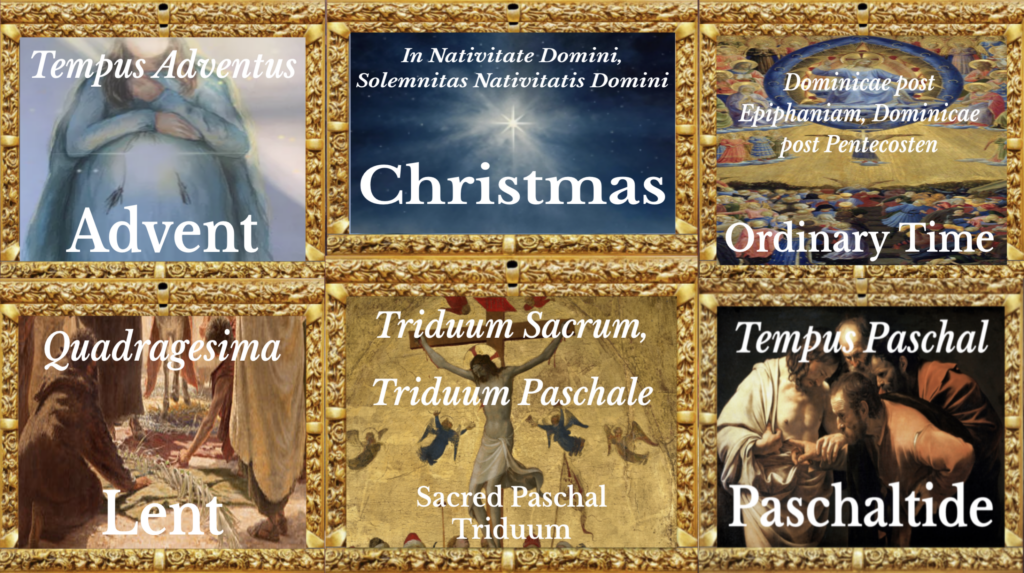
The Roman Rite of the Catholic Church observes six liturgical seasons in its annual calendar. While the Catechism of the Catholic Church outlines the significance of the liturgical year (referencing the cycle of feasts and prayer in paragraphs 1163–1173), the specific structural breakdown of the six seasons is formally detailed in the Vatican’s General Norms for the Liturgical Year and the Calendar.
These seasons are: Advent, Christmas, Lent, the Sacred Paschal Triduum, Easter, and Ordinary Time. They guide the faithful through the life, death, and resurrection of Jesus Christ.
Advent
Visit: Advent
Advent (from “ad-venire” in Latin, meaning “to come to”) means “coming” or “arrival” and is the season encompassing the four Sundays (and weekdays) leading up to the celebration of Christmas (25 December).
Name in Traditional Liturgy: Tempus Adventus (the Season of Advent)
Season Preceding Advent: Ordinary Time
Commences: Four Sundays Before Christmas
Final Days: The final days of Advent, from December 17 to December 24, focus particularly on our preparation for the celebrations of the Nativity of our Lord (Christmas).
Ends: 24 December
First Sunday of Advent (Ad Te Levavi)
Second Sunday of Advent (Populus Sion)
Third Sunday of Sunday (Guadete)
Fourth Sunday of Advent (Dominica Quarta in Adventu or Dominica IV Adventus or Rorate Sunday)
Feast of Saint Andrew the Apostle (Sancti Andreae Apostoli): 30 November
Feast of Saint Francis Xavier (Sancti Francisci Xaverii, Confessoris): 3 December
Feast of Saint Nicholas (Sancti Nicolai Episcopi et Confessoris): 6 December
Solemnity of the Immaculate Conception (In Conceptione Immaculata Beatae Mariae Virginis): 7 December
Feast of Our Lady of Guadalupe (Beata Maria Virgo de Guadalupe, In festo B. M. V. de Guadalupe)
Feast of Sunday Lucy (Beata Maria Virgo de Guadalupe, In festo B. M. V. de Guadalupe): 12 December
Feast of Saint Lucy (Sanctae Luciae Virginis et Martyris): 13 December
Feast of Saint John of the Cross (Sancti Ioannis a Cruce Confessoris et Ecclesiae Doctoris): 13 December
Christmas
Visit: Christmas
Christmas is the celebration of the Incarnation—the moment when God entered human history by becoming man in Jesus Christ. The word for Christmas in late O. E. is Cristes Maesse, the Mass of Christ, first found in 1038, and Cristes-messe, in 1131.
Name in Traditional Liturgy: In Nativitate Domini or Solemnitas Nativitatis Domini (Solemnity of the Nativity of the Lord)
Commences: Eve of 24 December
Final Days: The final days leading up to this conclusion include Epiphany and the compressed days of early January.
Ends: The official liturgical Christmas season concludes with the Feast of the Baptism of the Lord (usually the Sunday after Epiphany in early January), though traditional and historical calendars extend the final days all the way to Candlemas (Presentation of the Lord) on February 2nd.
The Nativity of the Lord (In Nativitate Domini): 25 December
Feast of Saint Stephen (Sancti Stephani Protomartyris): 26 December
Feast of Saint John the Apostle (Sancti Ioannis Apostoli et Evangelistae or In festo Sancti Ioannis Apostoli et Evangelistae): 27 December
Feast of the Holy Innocents (Festum Sanctorum Innocentium Martyrum): 28 December
Feast of the Holy Family (Festum Sanctae Familiae or Festum Sanctae Familiae Iesu, Mariae et Ioseph): Fourth Day in Octave
Solemnity of Mary, the Mother of God (Sollemnitas Sanctae Dei Genetricis Mariae, In octava Nativitatis Domini: Sollemnitas Sanctae Dei Genetricis Mariae): 1 January
The Epiphany of the Lord (Epiphania Domini or In Epiphania Domini): 6 January or First Sunday after 1 January
Baptism of the Lord (Festum Baptismatis Domini)
Ordinary Time
Visit: Ordinary Time
In the Catholic Church, Ordinary Time is the longest liturgical season of the year, spanning 33 or 34 weeks. This time does not belong to the specific seasons of Advent, Christmas, Lent, or Easter.
Name in Traditional Liturgy: Sundays after Epiphany, Sundays after Pentecost
Season Preceding Ordinary Time: Christmas, Easter
Primordial Feast Day Underlying Ordinary Time: Sunday (The Lord’s Day)
Commences: Commences on Monday after the Feast of the Baptism of the Lord and Monday after Pentecost Sunday
Ends: One Day Before Ash Wednesday, Saturday before the First Sunday of Advent
September Embertide (Michaelmas Embertide): Wednesday following the Feast of the Exaltation of the Holy Cross (14 September)
Conversion of St. Paul (In Conversione Sancti Pauli Apostoli): 25 January
Presentation of the Lord (In Praesentatione Domini, Purificatio Beatæ Mariæ Virginis (The Purification of the Blessed Virgin Mary): 2 February
Memorial of the Blessed Virgin Mary, Mother of the Church (Beata Maria Virgo, Ecclesiae Mater, Sanctae Mariae, Ecclesiae Matris): Monday after Pentecost
Holy Trinity Sunday (Solemnitas Sanctissimae Trinitatis, Dominica Sanctissimae Trinitatis): First Sunday after Pentecost
Feast of Corpus Christi (Sollemnitas Sanctissimi Corporis et Sanguinis Christi, Festum Corporis Christi, Dies Sanctissimi Corporis et Sanguinis Domini Iesu Christi): Thursday after Trinity Sunday (60 Days after Easter)
Feast of the Sacred Heart of Jesus (Sollemnitas Sacratissimi Cordis Iesu, In Festo Sanctissimi Cordis Jesu): Friday after the Solemnity of Corpus Christi (19 Days after Pentecost)
Feast of the Immaculate Heart of Mary (Festum Immaculati Cordis Beatæ Mariæ Virginis): Saturday following the Solemnity of the Sacred Heart of Jesus (Third Sunday of Pentecost)
Nativity of St. John the Baptist (Nativitas Sancti Ioannis Baptistae, In Nativitate Sancti Joannis Baptistae): 24 June
Feast of Sts. Peter and Paul (Solemnitas Sanctorum Apostolorum Petri et Pauli): 29 June
Feast of St. Thomas the Apostle (Sancti Thomae Apostoli): 3 July
Feast of St. Pier Giorgio Frassati (Memoria Sancti Petri Georgii Frassati): 4 July
Feast of Our Lady of Mount Carmel (Commemoratio Beatae Mariae Virginis de Monte Carmelo): 16 July
Feast of St. Mary Magdalene (Sanctæ Mariæ Magdalénæ, Sanctæ Mariæ Magdalénæ Poenitentis): 22 July
Feast of St. James the Greater (Festum Sancti Jacobi Maioris Apostoli, Sancti Jacobi Apostoli): 25 July
Dedication of St. Mary Major (In dedicatione basilicae S. Mariae, In Dedicatione Sanctae Mariae ad Nives): 5 August
The Transfiguration of the Lord (Transfiguratio Domini, n Transfiguratione D. N. Jesu Christi or Transfiguratio D. N. Jesu Christi): 6 August
Feast of St. Lawrence (Sancti Laurentii Martyris): 10 August
The Assumption of the Blessed Virgin Mary (Assumptio Beatæ Mariæ Virginis): 15 August
Feast of the Queenship of Mary (Festum Beatae Mariae Virginis Reginae, In Festo Beatae Mariae Virginis Reginae): 22 August
Feast of St. Bartholomew (Sancti Bartholomaei Apostoli): 24 August
The Nativity of the Blessed Virgin Mary (In Nativitas Beatæ Mariæ Virginis): 8 September
The Exaltation of the Holy Cross (Exaltatio Sanctae Crucis): 14 September
Feast of Our Lady of Sorrows (Septem Dolorum Beatae Mariae Virginis, Beatae Mariae Virginis Perdolentis): 15 September
Feast of Saint Matthew (Sancti Matthaei Apostoli et Evangelistae): 21 September
Feast of the Holy Archangels (Dedicatio Sancti Michaélis Archángeli, Sanctorum Michaelis, Gabrielis et Raphaelis, Archangelorum): 29 September
Feast of Guardian Angels (Festum Sanctorum Angelorum Custodum): 2 October
Feast of Our Lady of the Rosary (In Festo Beatae Mariae Virginis a Rosario, Festum Sanctissimi Rosarii): 7 October
Feast of St. Carlo Acutis (12 October)
Feast of St. Luke (Sancti Lucæ Evangelistæ): 18 October
Feast of Sts. Simon and Jude (Sanctorum Simonis et Judae Apostolorum, SS. Simonis et Judae Apostolorum): 28 October
All Saints’ Day (Solemnitas Omnium Sanctorum): 1 November
Commemoration of All the Faithful Departed / All Souls’ Day (Commemoratio Omnium Fidelium Defunctorum): 2 November
Dedication of the Lateran Basilica (Dedicatio Archibasilicae Sanctissimi Salvatoris, Dedicatio Basilicae Lateranensis): 9 November
Feast of Christ the King (Festum Domini nostri Jesu Christi Regis, Solemnitas D. N. Iesu Christi universorum Regis): Final Sunday of the liturgical year (the 34th Sunday in Ordinary Time), Sunday immediately preceding the First Sunday of Advent.
Lent
Visit: Lent
Lent is a solemn forty-day season marked by prayer, fasting, and almsgiving to prepare for Easter when the Church unites herself to the mystery of Jesus in the desert.
Name in Traditional Liturgy: Quadragesima (The Forty Days)
Season Preceding Christmas: Ordinary Time
Commences: Ash Wednesday (46 Days before Easter Sunday)
Ends: Lent officially concludes on the evening of Holy Thursday right before the Mass of the Lord’s Supper begins. This leads into the Sacred Triduum, marking the end of the 40-day Lenten season.
Ash Wednesday (Feria quarta cinerum, Dies cinerum): 46 Days before Easter Sunday
First Sunday of Lent (Quadragesima Sunday or Invocabit Sunday)
Second Sunday of Lent (Reminiscere Sunday)
Third Sunday of Lent (Oculi Sunday)
Fourth Sunday Lent (Laetare Sunday)
Fifth Sunday of Lent (Dominica in Ramis Palmarum (or Dominica Palmarum or Dominica in Palmis de Passione Domini)
Holy Thursday (Feria quinta in Cena Domini)
Solemnity of Saint Joseph (Sancti Joseph Sponsi Beatae Mariae Virginis, Confessoris): 19 March
Solemnity of the Annunciation (Annuntiatio Beatae Mariae Virginis): 25 March
Feast of Saints Perpetua and Felicity (Sanctorum Perpetuae et Felicitatis, martyrum): 7 March
The Sacred Paschal Triduum
Visit: Sacred Paschal Triduum
The three-day liturgical celebration of the Paschal Mystery (Passion, Death, and Resurrection of Jesus Christ) begins with the evening Mass of the Lord’s Supper on Holy Thursday. It concludes with evening prayer on Easter Sunday.
Name in Traditional Liturgy: Triduum Sacrum (the Sacred Triduum) or Triduum Paschale
Season Preceding Sacred Paschal Triduum: Lent
Commences: Evening Mass of the Lord’s Supper on Holy Thursday.
Peak: Easter Vigil
Ends: Evening Prayer/Vespers on Easter Sunday
Holy Thursday (Feria quinta in Cena Domini)
Chrism Mass (Holy Thursday)
The Foot Washing (Mandatum, Pedilavium) (Holy Thursday)
Transfer of the Eucharist to the Altar of Repose and Adoration of the Blessed Sacrament (Locus Repositionis)
The Stripping of the Altar (Denudatio Altaris) (Holy Thursday)
Good Friday (Feria sexta in Parasceve, Feria sexta in Passione Domini, or Feria sexta in Passione et Morte Domini): Second Day of Paschal Triduum
Paschaltide and Eastertide
Visit: Paschaltide and Eastertide
Easter celebrates Jesus’s resurrection, His victory over sin and death, and salvation for mankind; it is a floating holiday that falls on the first Sunday following the first full moon on or after the spring equinox (March 21). Easter is preceded by the Sacred Paschal Triduum—Holy Thursday, Good Friday, and the Easter Vigil. The word “Easter” comes from Old English and means “East.” The sun, which rises in the East, bringing light, warmth, and hope, is a symbol for the Christian of the rising Christ, who is the true Light of the world. The Paschal Candle used during the Easter Vigil is a central symbol of this divine light. In the Catholic Church, Ordinary Time is the longest liturgical season of the year, spanning 33 or 34 weeks. This time does not belong to the specific seasons of Advent, Christmas, Lent, or Easter.
Name in Traditional Liturgy: Dominica Resurrectionis or Dies Sanctus Paschae (Sunday of the Resurrection)
Season Preceding Sacred Paschal Triduum: Paschale Tridiuum
Commences: The first Sunday following the first ecclesiastical full moon that occurs on or after the vernal (spring) equinox, fixed at March 21. Easter vigil is held after night falls on Holy Saturday, the evening before Easter Sunday.
Ends: Easter season officially ends on Pentecost Sunday, which is 50 days after Easter Sunday.
Easter Vigil (Passchalis Vigilia, Vigilia Paschalis, Paschale Solemnitas, In Vigilia Paschali): Nightfall on Holy Saturday – Daybreak on Easter Sunday
The Liturgy of the Word (Liturgia Verbi) (Easter Vigil)
The Liturgy of Baptism (Benedictio Fontis, Liturgia Baptismalis) (Easter Vigil)
The Liturgy of the Eucharist (Liturgia eucharistiae, Liturgia eucharistica) (Easter Vigil)
The Octave of Easter (Octava Paschæ or Dominica in Albis in Octava Paschæ): Easter Sunday – Second Sunday of Easter
The Easter Season, Eastertide (Tempus Paschale, Quinquagesima Paschalis, Quinquagesima laetitiae, Festa paschalia): Easter Vigil – Pentecost Sunday
Google Images was used to collect the photographs on this page. The photographs do not belong to Global Catholic Resource Center©.

Share