

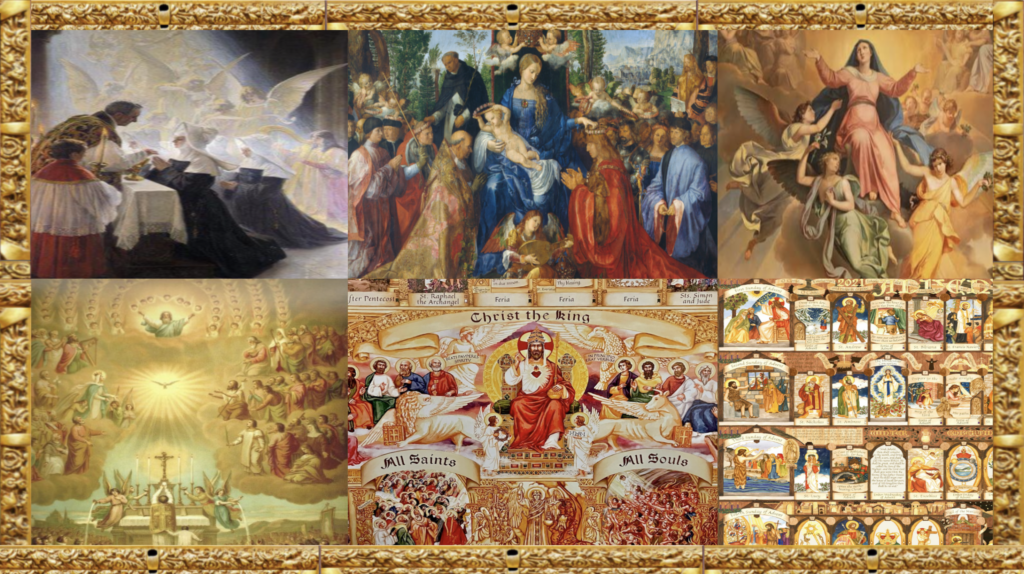
The information here may change before this webpage can be updated. Please consult your parish priest or other trusted resources to ensure the information is current.
Types of Liturgical Days
The Catholic Church categorizes its liturgical calendar into solemnities, feasts, and memorials, but only Sundays and specific Holy Days of Obligation require the faithful to participate in Mass.
Sundays (Dies Dominica) (Advent, Lent, Easter)
Solemnities (Sollemnitas)
Sundays in Ordinary Time (Dominica per annum)
Feast Days (Festum)
Memorials (Memoria)
Sundays
Sundays outrank regular feast days and memorials. Sundays in Advent, Lent, and Easter outrank all solemnities. If a major solemnity lands on a Sunday during Lent, the Sunday liturgy is used instead. Sundays in Ordinary Time rank very high, but they give way to major Solemnities (like the Assumption or All Saints’ Day) if a solemnity falls on that specific Sunday.
High Precedence (Tabula dierum liturgicorum secundum ordinem praecedentiae textum, Tabula Praecedentiae, Tabula Dierum Liturgicorum)
This designation includes major solemnities like Christmas, Epiphany, Ascension, and Pentecost; Sundays of Advent, Lent, and Easter; Ash Wednesday; Holy Week weekdays (Monday–Thursday); and the Easter Octave. The days of highest precedence are those which occur during the Sacred Paschal Triduum.
Solemnities (Sollemnitas)
A solemnity is a feast day of the highest rank in the liturgical calendar of the Roman Catholic Church, outranking all other feasts, memorials, and standard Sundays in Ordinary Time. If a lower celebration falls on the same day, the solemnity takes absolute precedence. During the Mass, both the Gloria (Glory to God) and the Nicene Creed are recited or sung, emphasizing the joyful and foundational nature of the mystery being honored.
Feast Days (Festum)
A designated day on the liturgical calendar dedicated to celebrating a mystery of faith, an event in the life of Jesus or the Blessed Virgin Mary, or the life and martyrdom of a saint. A saint’s feast day is an annual dedicated day on the Church’s liturgical calendar celebrating a canonized saint, usually on the date of their earthly death—viewed as their birth into heaven (dies natalis).
Memorials (Memoria)
A memorial is the lowest rank of a celebration and is a fixed day in the liturgical year where the Church on earth honors holy figures—starting with the Mother of God, followed by apostles, martyrs, and other saints. Keeping these days shows that the earthly Church is united with the liturgy of heaven. Obligatory memorials must be observed on the universal calendar when that specific saint’s day arrives. For optional memorials, the priest has the choice to celebrate the saint or use the standard readings and prayers for that ordinary weekday instead.
Advent
First Sunday of Advent
Type of Liturgical Day: High Precedence (Tabula Praecedentiae, Tabula Dierum Liturgicorum)
Name in Traditional Liturgy: Dominica I Adventus, Ad Te Levavi (To you I have lifted up)
Color: Purple or violet (a time of quiet waiting, penance, and preparation for the coming of Jesus).
Mass: The Gloria (“Glory to God”) is omitted during the Mass on the First Sunday of Advent, Lighting of the Advent Wreath
Office: Week I of the Standard Four-Week Psalter Cycle
Second Sunday of Advent
Type of Liturgical Day: High Precedence (Tabula Praecedentiae, Tabula Dierum Liturgicorum)
Name in Traditional Liturgy: Dominica II Adventus, Populus Sion (People of Zion)
Color: Purple or violet (a time of quiet waiting, penance, and preparation for the coming of Jesus).
Mass: The Gloria (“Glory to God”) is omitted during the Mass on the Second Sunday of Advent, Lighting of the Advent Wreath
Office: Week II of the Standard Four-Week Psalter Cycle
Third Sunday of Advent
Type of Liturgical Day: High Precedence (Tabula Praecedentiae, Tabula Dierum Liturgicorum)
Name in Traditional Liturgy: Gaudete
Color: Rose or Pink (marks a joyful pause halfway through the penitential season of Advent).
Mass: The Gloria (“Glory to God”) is omitted during the Mass on the Third Sunday of Advent, Lighting of the Advent Wreath
Office: Week III of the Standard Four-Week Psalter Cycle
Fourth Sunday of Advent
Type of Liturgical Day: High Precedence (Tabula Praecedentiae, Tabula Dierum Liturgicorum)
Name in Traditional Liturgy: Dominica Quarta in Adventu or Dominica IV Adventus
Color: Purple or violet (a time of quiet waiting, penance, and preparation for the coming of Jesus).
Mass: The Gloria (“Glory to God”) is omitted during the Mass on the Fourth Sunday of Advent, Lighting of the Advent Wreath
Office: Week IV of the Standard Four-Week Psalter Cycle
Feast of Saint Andrew the Apostle (30 November)
Type of Liturgical Day: Feast (Festum)
Name in Traditional Liturgy: Sancti Andreae Apostoli
Colors: Red
Mass: Gloria Added, Proper Collect, Preface of the Apostles Added
Office: Standard Four-Week Psalter Cycle
Commences: 30 November
Ends: 30 November (Midnight)
Feast of Saint Francis Xavier (3 December)
Type of Liturgical Day: Feast (Festum)
Name in Traditional Liturgy: Sancti Francisci Xaverii, Confessoris
Color: White
Office: Standard Four-Week Psalter Cycle
Commences: 3 December
Ends: 3 December (Midnight)
Feast of Saint Nicholas (6 December)
Type of Liturgical Day: Feast (Festum)
Name in Traditional Liturgy: Sancti Nicolai Episcopi et Confessoris
Color: White
Office: Standard Four-Week Psalter Cycle
Commences: 6 December
Ends: 6 December (Midnight)
Solemnity of the Immaculate of Conception
Type of Liturgical Day: Solemnity (Sollemnitas)
Name in Traditional Liturgy: In Conceptione Immaculata Beatae Mariae Virginis
Color: White (or Gold with a Regional Exception of Blue)
Mass: Gloria Added, Nicene Creed Added, Proper Collect, Proper Responsorial Psalm
Office: Proper Psalms (Pss Prop)
Commences: Evening of 7 December with First Vespers
Ends: 8 December (Midnight)
Feast of Our Lady of Guadalupe (12 December)
Type of Liturgical Day: Solemnity or Feast Depending on Country
Name in Traditional Liturgy: Beata Maria Virgo de Guadalupe, In festo B. M. V. de Guadalupe
Color: White (or Gold)
Mass: Specific Propers of Mass
Office: Common of the Blessed Virgin Mary and Standard Four-Week Psalter Cycle
Commences: 12 December
Ends: 12 December (Midnight)
Feast of Saint Lucy (13 December)
Type of Liturgical Day: Memorial (Memoria)
Name in Traditional Liturgy: Sanctae Luciae Virginis et Martyris
Color: Red
Mass: Specific Collect, Antiphons, Select Readings, Typical Eucharistic Mention,
Office: Standard Four-Week Psalter Cycle
Commences: 13 December
Ends: 13 December (Midnight)
Feast of Saint John of the Cross (13 December)
Type of Liturgical Day: Memorial (Memoria)
Name in Traditional Liturgy: Sancti Ioannis a Cruce Confessoris et Ecclesiae Doctoris
Color: White
Office: Standard Four-Week Psalter Cycle
Commences: 14 December
Ends: 14 December (Midnight)
Christmas and Christmastide
The Nativity of the Lord (25 December)
Type of Liturgical Day: Solemnity (Sollemnitas)
Name in Traditional Liturgy: In Nativitate Domini (The Nativity of the Lord)
Colors: White
Mass: The Christmas Proclamation (The Calends), Proper Communicantes, Genuflection during the Creed
Office: Proper Psalms (i.e., Psalm 63, Psalm 149, Psalm 110, Psalm 132)
Commences: 24 December (Sunset Vigil Mass)
Ends: The Octave (Dec. 25 – Jan. 1) ends on January 1 with the Solemnity of Mary, the Holy Mother of God.
Feast of Saint Stephen (26 December)
Type of Liturgical Day: Feast (Festum)
Name in Traditional Liturgy: Sancti Stephani Protomartyris
Colors: Red
Mass: Proper Antiphon, Preface of the Nativity, Communicantes with Eucharistic Prayer
Office: Sunday, Week I of the Four-Week Psalter
Commences: 26 December
Ends: 26 December (End)
Feast of Saint John the Apostle (27 December)
Type of Liturgical Day: Feast (Festum)
Name in Traditional Liturgy: Sancti Ioannis Apostoli et Evangelistae or In festo Sancti Ioannis Apostoli et Evangelistae
Colors: White
Mass: Proper Prayers and Antiphons, Proper Readings (i.e., 1 John 1:1–4, John 20:1a, 2–8)
Office: Special Psalmody
Commences: 27 December (Celebrated two days after Christmas, during the Christmas season (Christmastide).
Ends: 27 December (Midnight)
Feast of the Holy Innocents (28 December)
Type of Liturgical Day: Feast (Festum)
Name in Traditional Liturgy: Festum Sanctorum Innocentium Martyrum
Colors: Red
Office: Sunday, Week I of the Four-Week Psalter
Commences: 28 December
Ends: 28 December (Midnight)
Feast of the Holy Family
Type of Liturgical Day: Feast (Festum)
Name in Traditional Liturgy: Festum Sanctae Familiae or Festum Sanctae Familiae Iesu, Mariae et Ioseph
Colors: White
Office: Sunday, Week I of the Four-Week Psalter
Commences: The fourth day in the octave (eight-day period) of Christmas.
Ends: The fourth day in the octave (eight-day period) of Christmas (midnight).
Solemnity of Mary, the Mother of God (1 January)
Type of Liturgical Day: Solemnity (Sollemnitas)
Name in Traditional Liturgy: Sollemnitas Sanctae Dei Genetricis Mariae, In octava Nativitatis Domini: Sollemnitas Sanctae Dei Genetricis Mariae)
Colors: White (or Gold)
Mass: Gloria and Nicene Creed Added
Office: Week I of the Four-Week Psalter
Commences: 1 January
Ends: 1 January (Midnight)
The Epiphany of the Lord
Type of Liturgical Day: Solemnity (Sollemnitas)
Name in Traditional Liturgy: Epiphania Domini or In Epiphania Domini
Colors: White (or Gold)
Office: Proper psalms (Pss. Prop.)
Commences: 6 January or First Sunday after 1 January
Ends: Depends upon Date Celebrated
Baptism of the Lord (Sunday after the Epiphany)
Type of Liturgical Day: Feast (Festum)
Name in Traditional Liturgy: Festum Baptismatis Domini
Colors: White (or Gold)
Mass: Proper Prayers, Preface of the Baptism of the Lord, The Lectionary provides specific readings focused on the baptism of Jesus and the descent of the Holy Spirit (from Isaiah, Acts/Titus, and the Gospels of Matthew, Mark, or Luke depending on the liturgical year), Gloria and Creed Recited
Office: Week I of the Four-Week Psalter
Commences: If the Epiphany is transferred to Sunday, January 7 or January 8 (in regions where January 6 is not a holy day of obligation), the Baptism of the Lord is instead celebrated on the following Monday.
Ends: Depends upon Date Celebrated
Lent
Ash Wednesday
Type of Liturgical Day: High Precedence (Tabula Praecedentiae, Tabula Dierum Liturgicorum)
Name in Traditional Liturgy: Feria quarta cinerum (Wednesday of the ashes), or simply Dies cinerum (Day of Ashes)
Color: Violet (symbolizes penance, sacrifice, and purification as the Church enters the solemn season of Lent).
Mass: Penitential Act Omitted
Office: Wednesday of Week IV (4) of the four-week psalter
Commences: 46 Days before Easter Sunday
Ends: Dies liturgicus (the liturgical day), Decurrit a media nocte ad mediam noctem (runs from midnight to midnight.
First Sunday of Lent
Type of Liturgical Day: High Precedence (Tabula Praecedentiae, Tabula Dierum Liturgicorum)
Name in Traditional Liturgy: Quadragesima Sunday or Invocabit Sunday
Quadragesima Sunday: Latin for “Sunday in the fortieth,” reflecting the roughly 40-day period of Lent.
Invocabit Sunday: Named from the traditional Latin opening antiphon (Introit) for the day, Invocabit ad me (“He will call upon me”), derived from Psalm 91:15.
Color: Purple
Mass: Gloria Omitted
Office: Psalter Week I
Ends: Dies liturgicus (the liturgical day), Decurrit a media nocte ad mediam noctem (runs from midnight to midnight.
Second Sunday of Lent
Type of Liturgical Day: High Precedence (Tabula Praecedentiae, Tabula Dierum Liturgicorum)
Name in Traditional Liturgy: Reminiscere Sunday
Latin: From the first word of the traditional Latin Introit (entrance psalm) for the day, which begins with Psalm 25:6: “Reminiscere miserationum tuarum, Domine” (“Remember your mercy, O Lord”).
Color: Purple
Mass: Gloria Omitted
Office: Psalter Week II
Ends: Dies liturgicus (the liturgical day), Decurrit a media nocte ad mediam noctem (runs from midnight to midnight.
Third Sunday of Lent
Type of Liturgical Day: High Precedence (Tabula Praecedentiae, Tabula Dierum Liturgicorum)
Name in Traditional Liturgy: Oculi Sunday
Latin: From the Latin opening word of the Introit (entrance antiphon) for that day’s Mass, “Oculi mei semper ad Dominum” (“My eyes are ever toward the Lord”) from Psalm 24:15.
Color: Purple
Mass: Gloria Omitted
Office: Psalter Week III
Ends: Dies liturgicus (the liturgical day), Decurrit a media nocte ad mediam noctem (runs from midnight to midnight.
Fourth Sunday of Lent
Type of Liturgical Day: High Precedence (Tabula Praecedentiae, Tabula Dierum Liturgicorum)
Name in Traditional Liturgy: Laetare Sunday
Latin: Laetare means “rejoice”. The day offers a brief pause from penance to look forward to Easter. It marks the halfway point of the Lenten season.
Color: Purple (or Rose)
Mass: Gloria Omitted
Office: Psalter Week IV
Ends: Dies liturgicus (the liturgical day), Decurrit a media nocte ad mediam noctem (runs from midnight to midnight.
Fifth Sunday of Lent: Passion Sunday, Palm Sunday
Type of Liturgical Day: High Precedence (Tabula Praecedentiae, Tabula Dierum Liturgicorum)
Name in Traditional Liturgy: Dominica in Ramis Palmarum (or Dominica Palmarum or Dominica in Palmis de Passione Domini)
Latin: From the literal translation for “Sunday of the Palm Branches.” It marks the start of a two-week period before Easter known as Passiontide.
Color: Red
Mass: No Penitential Rite after Procession or Solemn Entrance, Gloria Omitted
Office: Psalter Week II
Ends: Dies liturgicus (the liturgical day), Decurrit a media nocte ad mediam noctem (runs from midnight to midnight.
Holy Thursday
Type of Liturgical Day: High Precedence (Tabula Praecedentiae, Tabula Dierum Liturgicorum)
Name in Traditional Liturgy: Feria quinta in Cena Domini
Latin: Feria quinta means “Thursday of the fifth day [of the week],” and in Cena Domini specifically references the Last Supper.
Color: White
Mass: Final Blessing and Formal Dismissal Omitted
Office: Psalter Week II
Ends: Dies liturgicus (the liturgical day), Decurrit a media nocte ad mediam noctem (runs from midnight to midnight.
Chrism Mass (Holy Thursday)
Type of Liturgical Day: High Precedence (Tabula Praecedentiae, Tabula Dierum Liturgicorum)
Name in Traditional Liturgy: In the traditional liturgy of the Roman Rite (prior to the 1955 reform of Holy Week), a separate “Chrism Mass” as an independent standalone mass did not have its own distinct proper name; instead, the blessing of the oils took place during the morning Mass of Holy Thursday, known in Latin as Feria Quinta in Cena Domini (“Thursday of the Supper of the Lord”).
Color: White
Mass: Gloria, Renewal of Commitment to Priestly Service, Creed & Intercessions Omitted, Blessing of Oils & Consecration of the Chrism, Preface of the Priesthood (Chrism Mass)
Commences: Morning of Holy Thursday
Ends: Dies liturgicus (the liturgical day), Decurrit a media nocte ad mediam noctem (runs from midnight to midnight.
The Foot Washing (Holy Thursday)
Type of Liturgical Day: High Precedence (Tabula Praecedentiae, Tabula Dierum Liturgicorum)
Name in Traditional Liturgy: Mandatum (Pedilavium)
Latin: From the Latin antiphon sung during the ceremony, “Mandatum novum do vobis” (“A new commandment I give unto you”), which quotes Jesus’s words in John 13:34 after he washed his disciples’ feet.
Color: White
Mass: Final Blessing and Formal Dismissal Omitted
Office: Psalter Week II
Ends: Dies liturgicus (the liturgical day), Decurrit a media nocte ad mediam noctem (runs from midnight to midnight.
Transfer of the Eucharist to the Altar of Repose and Adoration of the Blessed Sacrament
Type of Liturgical Day: High Precedence (Tabula Praecedentiae, Tabula Dierum Liturgicorum)
Name in Traditional Liturgy: Locus Repositionis (The Repository)
Latin: The specific enclosure or decorated space on that altar where the ciborium containing the Eucharist is placed.
Color: White
Mass: Final Blessing and Formal Dismissal Omitted
Office: Psalter Week II
Ends: Dies liturgicus (the liturgical day), Decurrit a media nocte ad mediam noctem (runs from midnight to midnight.
The Stripping of the Altar (Holy Thursday)
Type of Liturgical Day: High Precedence (Tabula Praecedentiae, Tabula Dierum Liturgicorum)
Name in Traditional Liturgy: Denudatio Altaris
Latin: It translates literally to the “stripping of the altar.”
The Act: After the Mass of the Lord’s Supper, all altar cloths, linens, and ornaments are removed. This represents Christ being stripped of His garments by the Roman soldiers before His crucifixion. Traditionally, Psalm 22 (Deus, Deus meus) is chanted or recited during the ceremony
Commences: Conclusion of Holy Thursday
Ends: The altar remains bare throughout Good Friday and Holy Saturday until the Easter Vigil begins.
Solemnity of Saint Joseph (19 March)
Type of Liturgical Day: Solemnity (Sollemnitas)
Name in Traditional Liturgy: Sancti Joseph Sponsi Beatae Mariae Virginis, Confessoris
Color: White or Gold
Mass: The Gloria in Excelsis Deo Added,
Office: Proper psalms and antiphon selections written specifically for the celebration of Saint Joseph are used for Morning Prayer, Evening Prayer, and the Office of Readings, supplemented by text from the Proper of Saints and the Common of Holy Men/1.2.4, 2.2.5.
Commences: 19 March
Ends: 19 March (Midnight)
Solemnity of the Annunciation
Type of Liturgical Day: Solemnity (Sollemnitas)
Name in Traditional Liturgy: Annuntiatio Beatae Mariae Virginis
Color: White (or Gold)
Mass: Gloria Added, Genuflection during Nicene Creed, Alleluia Omitted
Office: For the Solemnity of the Annunciation of the Lord (March 25), the proper psalmody assigned specifically to the solemnity is used for the hour, rather than the ordinary weekday psalter of the four-week cycle.
Commences: 25 March
Ends: 25 March (Evening)
Feast of Saints Perpetua and Felicity (7 March)
Type of Liturgical Day: Memorial (Memoria)
Name in Traditional Liturgy: Sanctorum Perpetuae et Felicitatis Martyrum
Color: Red (Changes to Violet if Feast falls on a Lenten Weekday)
Office: Standard Four-Week Psalter Cycle
Commences: 7 March
Ends: 7 March (Midnight)
The Sacred Paschal Triduum
Holy Thursday:
Type of Liturgical Day: High Precedence (Tabula Praecedentiae, Tabula Dierum Liturgicorum)
Name in Traditional Liturgy: Feria quinta in Cena Domini
Latin: Feria quinta means “Thursday of the fifth day [of the week],” and in Cena Domini specifically references the Last Supper.
Color: White
Mass: Final Blessing and Formal Dismissal Omitted
Office: Psalter Week II
Ends: Dies liturgicus (the liturgical day), Decurrit a media nocte ad mediam noctem (runs from midnight to midnight.
Chrism Mass (Holy Thursday)
Type of Liturgical Day: High Precedence (Tabula Praecedentiae, Tabula Dierum Liturgicorum)
Name in Traditional Liturgy: In the traditional liturgy of the Roman Rite (prior to the 1955 reform of Holy Week), a separate “Chrism Mass” as an independent standalone mass did not have its own distinct proper name; instead, the blessing of the oils took place during the morning Mass of Holy Thursday, known in Latin as Feria Quinta in Cena Domini (“Thursday of the Supper of the Lord”).
Color: White
Mass: Gloria, Renewal of Commitment to Priestly Service, Creed & Intercessions Omitted, Blessing of Oils & Consecration of the Chrism, Preface of the Priesthood (Chrism Mass)
Commences: Morning of Holy Thursday
Ends: Dies liturgicus (the liturgical day), Decurrit a media nocte ad mediam noctem (runs from midnight to midnight.
The Foot Washing (Holy Thursday)
Type of Liturgical Day: High Precedence (Tabula Praecedentiae, Tabula Dierum Liturgicorum)
Name in Traditional Liturgy: Mandatum (Pedilavium)
Latin: From the Latin antiphon sung during the ceremony, “Mandatum novum do vobis” (“A new commandment I give unto you”), which quotes Jesus’s words in John 13:34 after he washed his disciples’ feet.
Color: White
Mass: Final Blessing and Formal Dismissal Omitted
Office: Psalter Week II
Ends: Dies liturgicus (the liturgical day), Decurrit a media nocte ad mediam noctem (runs from midnight to midnight.
Transfer of the Eucharist to the Altar of Repose and Adoration of the Blessed Sacrament
Type of Liturgical Day: High Precedence (Tabula Praecedentiae, Tabula Dierum Liturgicorum)
Name in Traditional Liturgy: Locus Repositionis (The Repository)
Latin: The specific enclosure or decorated space on that altar where the ciborium containing the Eucharist is placed.
Color: White
Mass: Final Blessing and Formal Dismissal Omitted
Office: Psalter Week II
Ends: Dies liturgicus (the liturgical day), Decurrit a media nocte ad mediam noctem (runs from midnight to midnight.
The Stripping of the Altar (Holy Thursday)
Type of Liturgical Day: High Precedence (Tabula Praecedentiae, Tabula Dierum Liturgicorum)
Name in Traditional Liturgy: Denudatio Altaris
Latin: It translates literally to the “stripping of the altar.”
The Act: After the Mass of the Lord’s Supper, all altar cloths, linens, and ornaments are removed. This represents Christ being stripped of His garments by the Roman soldiers before His crucifixion. Traditionally, Psalm 22 (Deus, Deus meus) is chanted or recited during the ceremony
Commences: Conclusion of Holy Thursday
Ends: The altar remains bare throughout Good Friday and Holy Saturday until the Easter Vigil begins.
Good Friday
Type of Liturgical Day: Solemnity (Sollemnitas)
Name in Traditional Liturgy: Feria sexta in Parasceve, Feria sexta in Passione Domini (or Feria sexta in Passione et Morte Domini) (or Feria sexta in Passione et Morte Domini)
Latin: Feria sexta in Parasceve (Parasceve comes from the Greek word for preparation).
Color: Red
Mass: No Mass is celebrated. The Church holds a Celebration of the Lord’s Passion. This includes the Liturgy of the Word, Solemn Intercessions, Veneration of the Cross. Altars are left completely bare, church bells remain silent, and the church maintains a muted, somber tone. If Holy Communion is given, it is done with Hosts that were consecrated previously at the Mass of the Lord’s Supper on Maundy Thursday.
Commences: The second day of the Paschal Triduum, marking the solemn commemoration of the crucifixion and death of Jesus Christ.
Office: Psalm 2, Psalm 22, and Psalm 54 (or portions of them), which focus heavily on the Messiah’s suffering, betrayal, and trust in God. Daytime prayer uses the psalms assigned for Friday of Psalter Week II (with specific Lenten/passion antiphons and readings).
Ends: Good Friday ends at the beginning of the evening prayer of Holy Saturday. The Good Friday fast officially ends at midnight or is traditionally encouraged to continue through the Easter Vigil as the Paschal fast.
Easter Vigil
Type of Liturgical Day: Solemnity (Sollemnitas)
Name in Traditional Liturgy: Passchalis Vigilia, Vigilia Paschalis, Paschale Solemnitas, or In Vigilia Paschali (The Easter Vigil in the Holy Night).
Latin: The literal Latin translation for the Paschal or Easter Vigil.
Color: White and Gold
Mass: Standard Penitential Act Omitted, Creed Omitted, Gospel Candles Omitted, Opening Rites Omitted
Office: No standard weekly psalter is assigned to the Easter Vigil because the celebration itself takes the place of the Office of Readings (Matins) from the Divine Office.
Commences: Commences after nightfall on Holy Saturday.
Ends: Before dawn and the break of daylight on Easter Sunday.
The Service of Light (Lucernarium) (Easter Vigil)
Name in Traditional Liturgy: Lucernarium
Latin Derivative: The word comes from the Latin lucerna, meaning lamp or oil candle.
Color: White (or Gold)
Mass: Standard Penitential Act Omitted, Creed Omitted, Gospel Candles Omitted, Opening Rites Omitted
Office: No standard weekly psalter is assigned to the Easter Vigil because the celebration itself takes the place of the Office of Readings (Matins) from the Divine Office.
Commences: Commences after nightfall on Holy Saturday.
Ends: Ends immediately after the singing or chanting of the Exsultet (the Easter Proclamation), right before the beginning of the Liturgy of the Word
The Liturgy of the Word (Easter Vigil)
Type of Liturgical Day: Solemnity (Sollemnitas)
Name in Traditional Liturgy: Liturgia Verb
Latin: The phrase combines liturgia (from the Greek leitourgia, meaning a public service or work on behalf of the people) and verbi (the genitive form of verbum, meaning “of the word”).
Color: White (or Gold)
Mass: Standard Penitential Act Omitted, Creed Omitted, Gospel Candles Omitted, Opening Rites Omitted
Office: No standard weekly psalter is assigned to the Easter Vigil because the celebration itself takes the place of the Office of Readings (Matins) from the Divine Office.
Commences: Commences after nightfall on Holy Saturday immediately following the Service of Light (Lucernarium)
Ends: Ends after the Gospel Reading and Homily before the Liturgy of Baptism begins.
The Liturgy of Baptism (Easter Vigil)
Type of Liturgical Day: Solemnity (Sollemnitas)
Name in Traditional Liturgy: Benedictio Fontis or Liturgia Baptismalis.
Latin: Benedictio Fontis: The solemn blessing and consecration of the baptismal water during the Easter Vigil. Liturgia Baptismalis: The formal heading for the baptismal portion of the Vigil service in the Roman Missal.
Color: White (or Gold)
Mass: Standard Penitential Act Omitted, Creed Omitted, Gospel Candles Omitted, Opening Rites Omitted
Office: No standard weekly psalter is assigned to the Easter Vigil because the celebration itself takes the place of the Office of Readings (Matins) from the Divine Office.
Commences: Commences after nightfall on Holy Saturday and after the Liturgy of the Word.
Ends: Concludes with the Renewal of Baptismal Promises and the universal prayer (or universal intercessions/prayer of the faithful) that follows it.
The Liturgy of the Eucharist (Easter Vigil)
Type of Liturgical Day: Solemnity (Sollemnitas)
Name in Traditional Liturgy: Liturgia eucharistiae, Liturgia eucharistica
Latin: The Latin translates to “Liturgy of the Eucharist.”
Color: White (or Gold)
Mass: Standard Penitential Act Omitted, Creed Omitted, Gospel Candles Omitted, Opening Rites Omitted
Office: No standard weekly psalter is assigned to the Easter Vigil because the celebration itself takes the place of the Office of Readings (Matins) from the Divine Office.
Commences: Commences as the fourth and final part of the Easter Vigil, immediately following the Liturgy of Baptism (or the renewal of baptismal promises if there are no baptisms)
Ends: Ends before the Concluding Rite which includes the final blessing and solemn double Alleluia dismissal.
Easter and Paschaltide
The Octave of Easter
Type of Liturgical Day: Solemnity (Sollemnitas)
Name in Traditional Liturgy: Octava Paschæ or Dominica in Albis in Octava Paschæ
Latin: Octava Paschæ means the “Octave of Easter,” referring to the full sequence of eight celebratory days. The final Sunday carries the traditional designation Dominica in Albis because it marks the day when newly baptized Christians (“neophytes”) traditionally laid aside the white baptismal garments they had worn continuously since the Easter Vigil.
Color: White (Gold Ascents) (Symbolizing joy, light, and the Resurrection)
Mass: Additions such as The Gloria, The Easter Sequence (Victimæ paschali laudes), Double Alleluia at Dismissal, Proper Eucharistic Insertions (Special forms of Communicants: “In communion with those” and Hanc igitur, “Therefore, Lord, we pray”).
Office: The Liturgy of the Hours repeats the complete prayers and psalms from Sunday Week I every single day for Morning Prayer (Lauds) and Evening Prayer (Vespers). The entire week is treated as one continuous, extended feast day (a “single great Sunday”), meaning the four-week psalter rotation is suspended. During the octave days, the standard short responsories for Lauds, Vespers, and Compline are often substituted with Psalm 118:24 (“This is the day the Lord has made; let us be glad and rejoice in it”).
Commences: Easter Sunday
Ends: Second Sunday of Easter (Divine Mercy Sunday)
The Easter Season (Eastertide)
Name in Traditional Liturgy: Tempus Paschale, Quinquagesima Paschalis, Quinquagesima laetitiae, Festa paschalia.
Latin: Tempus Paschale: The literal liturgical term for the “Paschal Time” or Easter season spanning fifty days.
Quinquagesima: Derived from the Latin word quinquagesimus, which means “fiftieth”.
Paschalis: Derived from the Latin adjective paschalis, meaning “of Easter” or “relates to the Pasch (Passover/Easter)” (from pascha, Easter).
Festa paschalia: Translates directly to “Easter festivals” or “Paschal feasts” in the Roman Catholic Church.
Color: White (or gold) is used for the majority of Eastertide, from Easter Sunday through the Saturday before Pentecost (symbolizes light, purity, joy, and the glory of Christ’s resurrection).
Mass: The Double Alleluia: An extra “Alleluia” is added to the dismissal (Ite, missa est) and the response during the Octave of Easter and on Pentecost Sunday. Throughout the entire 50-day season, the Gospel acclamation features a prominent, repeated Alleluia.
The Sequence: A special poetic hymn or chant called the Sequence (Victimae paschali laudes) is sung or recited right before the Gospel acclamation on Easter Sunday and Pentecost. During the Liturgy of the Word, the first reading is taken from the Acts of the Apostles instead of the Old Testament, emphasizing the life of the early Church.
Special Eucharistic Insertions: Specific references acknowledging the joy of the season (such as proper Communicantes prayers) are added within Eucharistic Prayer I (the Roman Canon) during the Easter Octave.
Office: The hymns, short readings, responsories, and closing prayers are completely distinct for the 50 days of Easter and are pulled exclusively from the Proper of Seasons volume.
Commences: Commences with the Easter Vigil on Holy Saturday Night.
Ends: Pentecost Sunday (Spans 50 Days)
Ordinary Time
As of 2026, the following feast days are celebrated in Ordinary Time. There is a possibility that this information may change with time. Due to the extensive nature of feast days, this list does not include all of the feast days in Ordinary Time.
Conversion of St. Paul
Type of Liturgical Day: Feast (Festum)
Name in Traditional Liturgy: In Conversione Sancti Pauli Apostoli
Color: White
Mass: For the Feast of the Conversion of Saint Paul (celebrated on January 25) in the Roman Catholic Mass, the Gloria is added (sung or recited), but the Creed is omitted.
Office: Standard Four-Week Psalter Cycle: The Liturgy of the Hours provides specific antiphons, psalms, readings, and intercessions that focus on the dramatic conversion of Saul of Tarsus on the road to Damascus and his commissioning as the Apostle to the Gentiles.
Commences: 25 January
Ends: 25 January (Midnight)
Presentation of the Lord
Name in Traditional Liturgy: In Praesentatione Domini, Purificatio Beatæ Mariæ Virginis (The Purification of the Blessed Virgin Mary)
Type of Liturgical Day: Feast (Festum)
Color: White
Mass: The Roman Missal adds a special introductory ceremony involving the blessing of candles and a solemn procession, while the standard Penitential Act is omitted at the beginning of Mass.
Office: Psalter from Week 1 of the Four-Week Psalter
Commences: 2 February (40 Days After Christmas)
Ends: 2 February (40 Days After Christmas) (Midnight)
Memorial of the Blessed Virgin Mary, Mother of the Church
Type of Liturgical Day: Obligatory Memorial (Memoria)
Name in Traditional Liturgy: Beata Maria Virgo, Ecclesiae Mater (or Sanctae Mariae, Ecclesiae Matris)
Color: White
Mass: The standard sequential weekday readings and prayers of Ordinary Time (since this memorial falls on the Monday after Pentecost) are omitted and replaced entirely by the proper Marian formulary.
Office: Week IV of the Four-Week Psalter Cycle.
Commences: Monday after Pentecost
Ends: Monday after Pentecost (Midnight)
Holy Trinity Sunday
Name in Traditional Liturgy: Solemnitas Sanctissimae Trinitatis, Dominica Sanctissimae Trinitatis
Type of Liturgical Day: Solemnity (Sollemnitas)
Color: White
Mass: A specific prayer acknowledging the mystery of the triune God—Father, Son, and Holy Spirit. Unique readings assigned specifically to Trinity Sunday (such as Exodus 34, Daniel 3 as the Responsorial Psalm, 2 Corinthians 13, and John 3) replace the standard sequential readings of Ordinary Time. The Eucharistic prayer utilizes the Preface of the Most Holy Trinity, which explicitly praises God as one God and one Lord, not in a single person, but in three persons in one substance.
Office: Sunday, Week I of Standard Four-Week Psalter Cycle
Commences: First Sunday after Pentecost
Ends: First Sunday after Pentecost (Midnight)
Feast of Corpus Christi
Type of Liturgical Day: Solemnity (Sollemnitas)
Name in Traditional Liturgy: Sollemnitas Sanctissimi Corporis et Sanguinis Christi, Festum Corporis Christi (or Dies Sanctissimi Corporis et Sanguinis Domini Iesu Christi)
Color: White
Mass: The Lauda Sion can be added immediately before the Gospel Acclamation (Alleluia).
Office: The psalms used for Morning Prayer (Lauds), Evening Prayer (Vespers), and the Office of Readings are proper to the feast (Psalmi Proprii), chosen explicitly to reflect the themes of the Eucharist, priesthood, and God feeding His people, rather than recycling the day of the week from the regular 4-week psalter.
Commences: Thursday after Trinity Sunday (60 Days after Easter)
Ends: Thursday after Trinity Sunday (60 Days after Easter) (Midnight)
Feast of the Sacred Heart of Jesus
Type of Liturgical Day: Solemnity (Sollemnitas)
Name in Traditional Liturgy: Sollemnitas Sacratissimi Cordis Iesu, In Festo Sanctissimi Cordis Jesu
Color: White (or Gold)
Mass: The Gloria is sung or recited, and the Credo (Nicene Creed) is professed, which does not happen on standard weekdays.
Office: For the specific psalms and antiphons used during Morning and Evening Prayer on this day, the Church assigns Proper Psalmodies (custom selections written specifically for the feast) rather than standard Week I, II, III, or IV psalter numbers.
Commences: Friday after the Solemnity of Corpus Christi (19 Days after Pentecost)
Ends: Friday after the Solemnity of Corpus Christi (19 Days after Pentecost) (Midnight)
Feast of the Immaculate Heart of Mary
Type of Liturgical Day: Obligatory Memorial (Memoria)
Name in Traditional Liturgy: Festum Immaculati Cordis Beatæ Mariæ Virginis
Color: White
Mass: In the modern Ordinary Form of the Roman Rite, the celebration for the Immaculate Heart of the Blessed Virgin Mary is officially ranked as an obligatory memorial (celebrated on the Saturday following the Solemnity of the Sacred Heart of Jesus) rather than a higher-ranking Feast or Solemnity.
Office: Week II of the Four-Week Psalter Cycle.
Commences: Saturday following the Solemnity of the Sacred Heart of Jesus (Third Sunday of Pentecost)
Ends: Saturday following the Solemnity of the Sacred Heart of Jesus (Third Sunday of Pentecost) (Midnight)
Nativity of St. John the Baptist
Type of Liturgical Day: Solemnity (Sollemnitas)
Name in Traditional Liturgy: Nativitas Sancti Ioannis Baptistae, In Nativitate Sancti Joannis Baptistae
Color: White (or Gold)
Mass: The Gloria is Added, The Nicene-Constantinopolitan Creed is Added even if the feast falls on a weekday during Ordinary Time.
Office: The psalmody for daytime and evening prayer is taken from the Proper of Saints / Commons rather than a specific standard 4-week psalter week, with specific psalms assigned (such as Psalm 113 and Psalm 146 for Evening Prayer I)
Commences: 24 June
Ends: 24 June (Midnight)
Feast of Sts. Peter and Paul (29 June)
Type of Liturgical Day: Solemnity (Sollemnitas)
Name in Traditional Liturgy: Solemnitas Sanctorum Apostolorum Petri et Pauli
Color: Red
Mass: The Gloria is Added, The Nicene-Constantinopolitan Creed is Added even if the feast falls on a weekday during Ordinary Time.
Office: The Solemnity of Saints Peter and Paul (June 29) uses its own proper psalmody (specific psalms assigned directly to the feast) rather than a standard four-week psalter cycle week.
Commences: Commences liturgically on the evening of June 28th with the celebration of First Vespers (Vigil), and the primary feast day is observed on June 29th
Ends: 29 June (Midnight)
Feast of St. Thomas the Apostle (3 July)
Type of Liturgical Day: Feast (Festum)
Name in Traditional Liturgy: Sancti Thomae Apostoli
Color: Red
Mass: Gloria Added, Creed Omitted
Office: Sunday, Week I (Week 1) of Standard Four-Week Psalter Cycle
Commences: 3 July
Ends: 3 July (Midnight)
Feast of St. Pier Giorgio Frassati (4 July)
Type of Liturgical Day: Memorial (Memoria)
Name in Latin: Memoria Sancti Petri Georgii Frassati
Color: White
Office: Standard Four-Week Psalter Cycle
Commences: 4 July
Ends: 4 July (Midnight)
Feast of Our Lady of Mount Carmel (16 July)
Type of Liturgical Day: Memorial (Memoria)
Name in Traditional Liturgy: Commemoratio Beatae Mariae Virginis de Monte Carmelo
Color: White
Mass: Nothing Added or Omitted
Office: Week III of of Standard Four-Week Psalter Cycle
Commences: 16 July
Ends: 16 July (Midnight)
Feast of St. Mary Magdalene (22 July)
Type of Liturgical Day: Feast (Festum)
Name in Traditional Liturgy: Sanctæ Mariæ Magdalénæ, Sanctæ Mariæ Magdalénæ Poenitentis
Color: White
Mass: The Gloria is Added, The Nicene-Constantinopolitan Creed is Added even if the feast falls on a weekday during Ordinary Time.
Office: Week IV of of Standard Four-Week Psalter Cycle
Commences: 22 July
Ends: 22 July (Midnight)
Feast of St. James the Greater (25 July)
Type of Liturgical Day: Feast (Festum)
Name in Traditional Liturgy: Festum Sancti Jacobi Maioris Apostoli, Sancti Jacobi Apostoli)
Color: Red
Mass: Gloria Added, Creed Omitted
Office: Standard Four-Week Psalter Cycle
Commences: 25 July
Ends: 25 July (Midnight)
Dedication of St. Mary Major (5 August)
Type of Liturgical Day: Memorial (Memoria)
Name in Traditional Liturgy: In dedicatione basilicae S. Mariae, In Dedicatione Sanctae Mariae ad Nives
Color: White
Mass: During the festal liturgy at the physical basilica in Rome, a dramatic visual tradition occurs where a shower of white rose petals falls from the ceiling during the liturgy to recreate the legend of the 4th-century summer snow.
Office: of Standard Four-Week Psalter Cycle (often Psalter Week II)
Commences: 5 August
Ends: 5 August (Midnight)
The Transfiguration of the Lord (6 August)
Type of Liturgical Day: Feast (Festum)
Name in Traditional Liturgy: Transfiguratio Domini, n Transfiguratione D. N. Jesu Christi or Transfiguratio D. N. Jesu Christi
Color: White
Mass: Standard Penitential Act Omitted, Solemn Procession, Nicene Creed, and Third Reading Added
Office: For Morning Prayer (Lauds) it borrows the psalms and canticle from Sunday, Psalter Week I. For other hours like Midday Prayer, it follows the specific weekday psalter corresponding to the day of the week it falls on (for instance, Week II of the four-week psalter if August 6 falls on a Thursday).
Commences: 6 August
Ends: 6 August (Midnight)
Feast of St. Lawrence (10 August)
Name in Traditional Liturgy: Sancti Laurentii Martyris
Type of Liturgical Day: Feast (Festum)
Color: Red
Mass: Gloria Added, The general weekday prayers are replaced with texts entirely specific to St. Lawrence. This includes a Proper Collect (opening prayer honoring his martyrdom), a specific Preface of Holy Martyrs, and proper Entrance and Communion Antiphons centered on his identity as a deacon who cared for the poor
Office: Standard Four-Week Psalter Cycle, Drawing Morning Psalms from Sunday Week I
Commences: 10 August
Ends: 10 August (Midnight)
The Assumption of the Blessed Virgin Mary (15 August)
Type of Liturgical Day: Solemnity (Sollemnitas)
Name in Traditional Liturgy: In Assumptione Beatæ Mariæ Virginis, Assumptio Beatæ Mariæ Virginis
Color: White (or Gold)
Mass: Gloria Added, Nicene-Constantinopolitan Creed Added (even if during a weekday)
Office: The Solemnity of the Assumption of the Blessed Virgin Mary (August 15) does not use a standard weekly psalter of Ordinary Time; instead, it uses proper psalms and texts assigned specifically to the Common of the Blessed Virgin Mary or proper antiphons and psalms designated for the feast.
Commences: 15 August
Ends: 15 August (Midnight)
Feast of the Queenship of Mary (22 August)
Type of Liturgical Day: Memorial (Memoria)
Name in Traditional Liturgy: Festum Beatae Mariae Virginis Reginae (or In Festo Beatae Mariae Virginis Reginae)
Color: White (or Gold)
Mass: Gloria and Nicene Creed Omitted, No Second Reading
Office: Psalter Week IV of Standard Four-Week Psalter Cycle
Commences: 22 August
Ends: 22 August (Midnight)
Feast of St. Bartholomew (24 August)
Type of Liturgical Day: Feast (Festum)
Name in Traditional Liturgy: Sancti Bartholomaei Apostoli
Color: Red
Mass: Gloria Added, Creed Omitted, No Third Reading
Office: Psalms and canticles for Morning Prayer (Lauds) are taken from Sunday, Week I.
Commences: 24 August
Ends: 24 August (Midnight)
The Nativity of the Blessed Virgin Mary (8 September)
Type of Liturgical Day: Feast (Festum)
Name in Traditional Liturgy: Nativitas Beatæ Mariæ Virginis
Color: White (with Gold)
Mass: Gloria Added, Creed Omitted
Office: Sunday, Psalter Week I of Standard Four-Week Psalter Cycle
Commences: 8 September
Ends: 8 September (Midnight)
The Exaltation of the Holy Cross (14 September)
Type of Liturgical Day: Feast (Festum)
Name in Traditional Liturgy: In Exaltatione Sanctae Crucis
Color: Red
Mass: Gloria Added
Office: Week IV of Standard Four-Week Psalter Cycle
Commences: 14 September
Ends: 14 September (Midnight)
Feast of Our Lady of Sorrows (15 September)
Type of Liturgical Day: Memorial (Memoria)
Name in Traditional Liturgy: Septem Dolorum Beatae Mariae Virginis, Beatae Mariae Virginis Perdolentis
Color: White
Mass: The Stabat Mater can be recited.
Office: Standard Four-Week Psalter Cycle
Commences: 15 September
Ends: 15 September (Midnight)
Feast of Saint Matthew (21 September)
Type of Liturgical Day: Feast (Festum)
Name in Traditional Liturgy: Sancti Matthaei Apostoli et Evangelistae
Color: Red
Mass: Gloria Added, Creed Omitted, Two Readings (If Celebrated on Weekday)
Office: Standard Four-Week Psalter Cycle
Commences: 21 September
Ends: 21 September (Midnight)
Feast of the Holy Archangels (29 September)
Type of Liturgical Day: Feast (Festum)
Name in Traditional Liturgy: Dedicatio Sancti Michaélis Archángeli, Sanctorum Michaelis, Gabrielis et Raphaelis, Archangelorum, SS. Michaelis, Gabrielis et Raphaelis, Archangelorum
Color: White (or Gold)
Mass: Gloria Added, Creed Omitted, Second Reading Omitted (on Weekdays)
Office: Standard Four-Week Psalter Cycle
Commences: 29 September
Ends: 29 September (Midnight)
Feast of Guardian Angels (2 October)
Type of Liturgical Day: Memorial (Memoria)
Name in Traditional Liturgy: Sanctorum Angelorum Custodum
Color: White
Mass: When celebrated on a weekday, the Gloria is omitted, the creed is omitted, and the second reading is omitted. When it falls on a Sunday, the entire Guardian Angel Mass is typically omitted.
Office: Standard Four-Week Psalter Cycle
Commences: 2 October
Ends: 2 October (Midnight)
Feast of Our Lady of the Rosary (7 October)
Type of Liturgical Day: Memorial (Memoria)
Name in Traditional Liturgy: In Festo Beatae Mariae Virginis a Rosario (or Festum Sanctissimi Rosarii)
Color: White
Office: Standard Four-Week Psalter Cycle
Commences: 7 October
Ends: 7 October (Midnight)
Feast of St. Carlo Acutis (12 October)
Type of Liturgical Day: Memorial (Memoria)
Color: White
Name in Latin: Sancti Caroli Acutis, Memoria Sancti Caroli
Office: Standard Four-Week Psalter Cycle
Commences: 12 October
Ends: 12 October (Midnight)
Feast of St. Luke (18 October)
Type of Liturgical Day: Feast (Festum)
Name in Traditional Liturgy: Sancti Lucæ Evangelistæ
Color: Red
Mass: Creed Omitted, No Third Readings
Office: Standard Four-Week Psalter Cycle
Commences: 18 October
Ends: 18 October (Midnight)
Feast of Sts. Simon and Jude (28 October)
Type of Liturgical Day: Feast (Festum)
Name in Traditional Liturgy: Sanctorum Simonis et Judae Apostolorum, SS. Simonis et Judae Apostolorum
Color: Red
Mass: Gloria Added, Proper Festal Prayers Added, Preface of the Apostles Added, Creed Omitted, Third Reading Omitted
Office: Standard Four-Week Psalter Cycle
Commences: 28 October
Ends: 28 October (Midnight)
All Saints’ Day (1 November)
Type of Liturgical Day: Solemnity (Sollemnitas)
Name in Traditional Liturgy: Solemnitas Omnium Sanctorum
Color: White (or Gold)
Mass: Gloria Added, Second Reading Added, Nicene Creed Added, The Entrance Antiphon, specific Readings like Revelation 7 or the Beatitudes in Matthew 5, the Responsorial Psalm, and the Opening Collect Prayer) are entirely specific to All Saints’ Day rather than the current week of Ordinary Time.
Office: Sunday, Week I of the Standard Four-Week Psalter Cycle
Commences: 1 November
Ends: 1 November (Midnight)
Commemoration of All the Faithful Departed / All Souls’ Day (2 November)
Type of Liturgical Day: Sollemnitas Omnium Sanctorum, Festum Omnium Sanctorum, In Festo Omnium Sanctorum
Name in Traditional Liturgy: In Commemoratione Omnium Fidelium Defunctorum
Color: Black or Violet (Purple) (White is Used in Some Regions)
Mass: Gloria and Creed Omitted
Office: Office of the Dead (Officium Defunctorum)
Commences: 2 November
Ends: 2 November (Midnight)
Dedication of the Lateran Basilica (9 November)
Type of Liturgical Day: Feast (Festum)
Name in Traditional Liturgy: Dedicatio Archibasilicae Sanctissimi Salvatoris, Dedicatio Basilicae Lateranensis
Color: White
Mass: Gloria Added, Creed Added
Office: Standard Four-Week Psalter Cycle, Drawn primarily from the Common of the Dedication of a Church in the Liturgy of the Hours.
Commences: 9 November
Ends: 9 November (Midnight)
Feast of Christ the King
Type of Liturgical Day: Solemnity (Sollemnitas)
Name in Traditional Liturgy: Dominini Nostri Iesu Christi universorum Regis, Solemnitas D. N. Iesu Christi universorum Regis
Color: White (or Gold)
Mass: Introit Added, Proper Collect, Alleluia Sequence Added
Office: Because Christ the King is a major Solemnity of the Lord falling on the last Sunday of Ordinary Time, it bypasses the standard Sunday psalter and uses a special psalmody.
Commences: Final Sunday of the liturgical year (the 34th Sunday in Ordinary Time), which is the Sunday immediately preceding the First Sunday of Advent.
Ends: Midnight on the final Sunday of the liturgical year (the 34th Sunday in Ordinary Time), which is the Sunday immediately preceding the First Sunday of Advent.
Google Images was used to collect the photographs on this page. The photographs do not belong to Global Catholic Resource Center©.

Share