

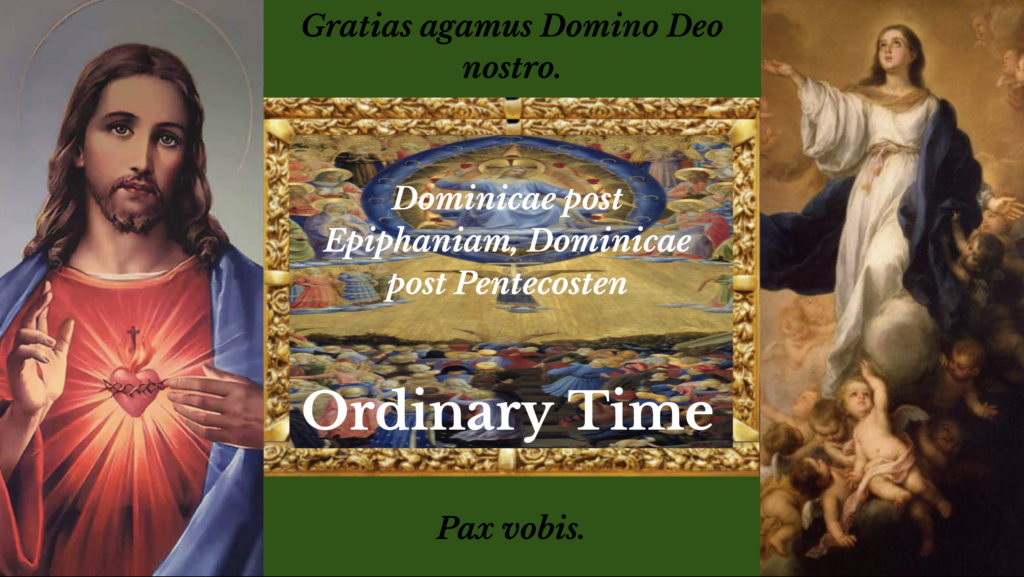
The information here may change before this webpage can be updated. Please consult your parish priest or other trusted resources to ensure the information is current.
Ordinary Time
In the Catholic Church, Ordinary Time is the longest liturgical season of the year, spanning 33 or 34 weeks. This time does not belong to the specific seasons of Advent, Christmas, Lent, or Easter.
Name in Traditional Liturgy: Dominicae post Epiphaniam, Dominicae post Pentecosten (Sundays after Epiphany, Sundays after Pentecost)
Season Preceding Ordinary Time: Christmas, Easter
Primordial Feast Day Underlying Ordinary Time: Sunday (The Lord’s Day)
Commences: Commences on Monday after the Feast of the Baptism of the Lord and Monday after Pentecost Sunday
Ends: One Day Before Ash Wednesday, Saturday before the First Sunday of Advent
The Catechism and Ordinary Time:
1171 In the liturgical year the various aspects of the one Paschal mystery unfold. This is also the case with the cycle of feasts surrounding the mystery of the incarnation (Annunciation, Christmas, Epiphany). They commemorate the beginning of our salvation and communicate to us the first fruits of the Paschal mystery.
September Embertide (Michaelmas Embertide)
The Ember Days are four sets of three days (Wednesday, Friday, and Saturday) that occur around the transitions of the natural seasons – winter, spring, summer, and autumn. In the traditional Western Christian Calendar, September Embertide (also called Fall Ember Days or Michaelmas Embertide) is a seasonal period of prayer, fasting, and thanksgiving observed on the Wednesday, Friday, and Saturday of the week following the Feast of the Exaltation of the Holy Cross (September 14). Historically, the Ember Days were days of penance observed to give thanks to God for His blessings in the previous season and to ask for His blessings for the upcoming one. In 1962, Ember Wednesday and Saturday were days of fasting and partial abstinence – that is, one could take only one full meal and two little meals, and meat only at the main meal. The Ember Days were also seen as days of prayer for those who were to be ordained, as ordinations were historically held on the Ember Saturdays. The practice of having ordinations on Ember Saturdays is still reflected in the Masses for the Ember Saturdays and the ordination rites themselves. While there is no current canonical obligation to keep the upcoming Ember Days as days of penance, the reader is invited voluntarily to do so. Even if one cannot keep them as days of fasting and abstinence, the reader is encouraged to do some form of penance on these three days and to keep them with the same spirit and intentions as our Catholic forefathers – in thanksgiving for the blessings of the previous season, to ask God’s blessing for the upcoming one, and to pray for the clergy, particularly for those studying for the Priesthood. As part of the keeping of the Ember Days, seafood tempura is suggested.
Name in Traditional Liturgy: Quatuor Tempora Septembris
Latin: Ember Days of September
Commences: Wednesday following the Feast of the Exaltation of the Holy Cross (14 September)
Ends: Wednesday following the Feast of the Exaltation of the Holy Cross (14 September) (Midnight)
Color: Green (Historically, violet)
Mass: Gloria Omitted, Alleluia Omitted, Flectamus Genua Exception on Sunday
Of Embertide: Ember Wednesday, Ember Saturday
Office: Standard Four-Week Psalter Cycle
Code of Canon Law and Daily Roman Missal
The Catechism and Ordinary Time:
2192 “Sunday . . . is to be observed as the foremost holy day of obligation in the universal Church” (CIC, can. 1246 § 1). “On Sundays and other holy days of obligation the faithful are bound to participate in the Mass” (CIC, can. 1247).
Daily Roman Missal
Ordinary Time contains thirty-three or thirty-four weeks. It begins on the Monday following the Sunday after January 6 and continues until the beginning of Lent; it begins again on the Monday after Pentecost Sunday and ends on the Saturday before the First Sunday of Advent.
The numbering of Sundays and weeks in Ordinary Time is calculated as follows:
a) The Sunday on which the Feast of the Baptism of the Lord occurs takes the place of the first Sunday in Ordinary Time; the week that follows is counted as the first week in Ordinary Time. The remaining Sundays and weeks are numbered in order until the beginning of Lent.
b) If there are thirty-four weeks in Ordinary Time, after Pentecost the series is resumed with the week that follows immediately the last week celebrated before Lent; it should be noted, however, that the Masses of Pentecost Sunday and of the Solemnity of the Most Holy Trinity take the place of the Sunday Masses. If, however, there are thirtythree weeks in Ordinary Time, the first week that would otherwise follow Pentecost is omitted.
Thus, in the Missal, thirty-four Masses for the Sundays and weekdays in Ordinary Time are found. They are used in this way:
a) On Sundays the Mass corresponding to the number of the Sunday in Ordinary Time is ordinarily used, unless there occurs a Solemnity or a Feast of the Lord which takes the place of the Sunday.
b) On weekdays, however, any of the thirty-four Masses may be used, provided the pastoral needs of the faithful are taken into consideration.
The Gloria in excelsis (Glory to God in the highest) and the Creed are said on Sundays, Solemnities and major feast days; on other weekdays, however, both are omitted.
Unless a Eucharistic Prayer is used that has a proper Preface, on Sundays one of the Prefaces for Sundays in Ordinary Time is said; but on weekdays, a Common Preface is said.
Two antiphons are provided for Communion, the first from the Psalms, and the second for the most part from the Gospel. One or the other may be selected, as circumstances suggest, but preference should be given to an antiphon that is in harmony with the Gospel of the Mass.
The Structure of Ordinary Time
First Period: Starts on the Monday after the Feast of the Baptism of the Lord (the end of Christmas time) and runs until the Tuesday before Ash Wednesday.
Name in Traditional Liturgy: Tempus post Epiphaniam (the Time or Season after Epiphany)
Commences and Ends: It begins on January 14 (following the Octave of the Epiphany and the Baptism of the Lord) and continues until the Saturday before Septuagesima Sunday (the pre-Lenten season).
Second Period: Starts on the Monday after Pentecost Sunday (the end of Easter time) and continues until the Saturday before the First Sunday of Advent.
Name in Traditional Liturgy: Tempus post Pentecosten (Weeks after Pentecost)
Commences and Ends: The time after Pentecost (tempus post Pentecosten), which continues until Advent.
Liturgical Days in Ordinary Time
As of 2026, the following feast days are celebrated in Ordinary Time. There is a possibility that this information may change with time. Due to the extensive nature of feast days, this list does not include all of the feast days in Ordinary Time.
Conversion of St. Paul
Type of Liturgical Day: Feast (Festum)
Name in Traditional Liturgy: In Conversione Sancti Pauli Apostoli
Color: White
Mass: For the Feast of the Conversion of Saint Paul (celebrated on January 25) in the Roman Catholic Mass, the Gloria is added (sung or recited), but the Creed is omitted.
Office: Standard Four-Week Psalter Cycle: The Liturgy of the Hours provides specific antiphons, psalms, readings, and intercessions that focus on the dramatic conversion of Saul of Tarsus on the road to Damascus and his commissioning as the Apostle to the Gentiles.
Commences: 25 January
Ends: 25 January (Midnight)
Presentation of the Lord
Name in Traditional Liturgy: In Praesentatione Domini, Purificatio Beatæ Mariæ Virginis (The Purification of the Blessed Virgin Mary)
Type of Liturgical Day: Feast (Festum)
Color: White
Mass: The Roman Missal adds a special introductory ceremony involving the blessing of candles and a solemn procession, while the standard Penitential Act is omitted at the beginning of Mass.
Office: Psalter from Week 1 of the Four-Week Psalter
Commences: 2 February (40 Days After Christmas)
Ends: 2 February (40 Days After Christmas) (Midnight)
Memorial of the Blessed Virgin Mary, Mother of the Church
Type of Liturgical Day: Obligatory Memorial (Memoria)
Name in Traditional Liturgy: Beata Maria Virgo, Ecclesiae Mater (or Sanctae Mariae, Ecclesiae Matris)
Color: White
Mass: The standard sequential weekday readings and prayers of Ordinary Time (since this memorial falls on the Monday after Pentecost) are omitted and replaced entirely by the proper Marian formulary.
Office: Week IV of the Four-Week Psalter Cycle.
Commences: Monday after Pentecost
Ends: Monday after Pentecost (Midnight)
Holy Trinity Sunday
Name in Traditional Liturgy: Solemnitas Sanctissimae Trinitatis, Dominica Sanctissimae Trinitatis
Type of Liturgical Day: Solemnity (Sollemnitas)
Color: White
Mass: A specific prayer acknowledging the mystery of the triune God—Father, Son, and Holy Spirit. Unique readings assigned specifically to Trinity Sunday (such as Exodus 34, Daniel 3 as the Responsorial Psalm, 2 Corinthians 13, and John 3) replace the standard sequential readings of Ordinary Time. The Eucharistic prayer utilizes the Preface of the Most Holy Trinity, which explicitly praises God as one God and one Lord, not in a single person, but in three persons in one substance.
Office: Sunday, Week I of Standard Four-Week Psalter Cycle
Commences: First Sunday after Pentecost
Ends: First Sunday after Pentecost (Midnight)
Feast of Corpus Christi
Type of Liturgical Day: Solemnity (Sollemnitas)
Name in Traditional Liturgy: Sollemnitas Sanctissimi Corporis et Sanguinis Christi, Festum Corporis Christi (or Dies Sanctissimi Corporis et Sanguinis Domini Iesu Christi)
Color: White
Mass: The Lauda Sion can be added immediately before the Gospel Acclamation (Alleluia).
Office: The psalms used for Morning Prayer (Lauds), Evening Prayer (Vespers), and the Office of Readings are proper to the feast (Psalmi Proprii), chosen explicitly to reflect the themes of the Eucharist, priesthood, and God feeding His people, rather than recycling the day of the week from the regular 4-week psalter.
Commences: Thursday after Trinity Sunday (60 Days after Easter)
Ends: Thursday after Trinity Sunday (60 Days after Easter) (Midnight)
Feast of the Sacred Heart of Jesus
Type of Liturgical Day: Solemnity (Sollemnitas)
Name in Traditional Liturgy: Sollemnitas Sacratissimi Cordis Iesu, In Festo Sanctissimi Cordis Jesu
Color: White (or Gold)
Mass: The Gloria is sung or recited, and the Credo (Nicene Creed) is professed, which does not happen on standard weekdays.
Office: For the specific psalms and antiphons used during Morning and Evening Prayer on this day, the Church assigns Proper Psalmodies (custom selections written specifically for the feast) rather than standard Week I, II, III, or IV psalter numbers.
Commences: Friday after the Solemnity of Corpus Christi (19 Days after Pentecost)
Ends: Friday after the Solemnity of Corpus Christi (19 Days after Pentecost) (Midnight)
Feast of the Immaculate Heart of Mary
Type of Liturgical Day: Obligatory Memorial (Memoria)
Name in Traditional Liturgy: Festum Immaculati Cordis Beatæ Mariæ Virginis
Color: White
Mass: In the modern Ordinary Form of the Roman Rite, the celebration for the Immaculate Heart of the Blessed Virgin Mary is officially ranked as an obligatory memorial (celebrated on the Saturday following the Solemnity of the Sacred Heart of Jesus) rather than a higher-ranking Feast or Solemnity.
Office: Week II of the Four-Week Psalter Cycle.
Commences: Saturday following the Solemnity of the Sacred Heart of Jesus (Third Sunday of Pentecost)
Ends: Saturday following the Solemnity of the Sacred Heart of Jesus (Third Sunday of Pentecost) (Midnight)
Nativity of St. John the Baptist
Type of Liturgical Day: Solemnity (Sollemnitas)
Name in Traditional Liturgy: Nativitas Sancti Ioannis Baptistae, In Nativitate Sancti Joannis Baptistae
Color: White (or Gold)
Mass: The Gloria is Added, The Nicene-Constantinopolitan Creed is Added even if the feast falls on a weekday during Ordinary Time.
Office: The psalmody for daytime and evening prayer is taken from the Proper of Saints / Commons rather than a specific standard 4-week psalter week, with specific psalms assigned (such as Psalm 113 and Psalm 146 for Evening Prayer I)
Commences: 24 June
Ends: 24 June (Midnight)
Feast of Sts. Peter and Paul (29 June)
Type of Liturgical Day: Solemnity (Sollemnitas)
Name in Traditional Liturgy: Solemnitas Sanctorum Apostolorum Petri et Pauli
Color: Red
Mass: The Gloria is Added, The Nicene-Constantinopolitan Creed is Added even if the feast falls on a weekday during Ordinary Time.
Office: The Solemnity of Saints Peter and Paul (June 29) uses its own proper psalmody (specific psalms assigned directly to the feast) rather than a standard four-week psalter cycle week.
Commences: Commences liturgically on the evening of June 28th with the celebration of First Vespers (Vigil), and the primary feast day is observed on June 29th
Ends: 29 June (Midnight)
Feast of St. Thomas the Apostle (3 July)
Type of Liturgical Day: Feast (Festum)
Name in Traditional Liturgy: Sancti Thomae Apostoli
Color: Red
Mass: Gloria Added, Creed Omitted
Office: Sunday, Week I (Week 1) of Standard Four-Week Psalter Cycle
Commences: 3 July
Ends: 3 July (Midnight)
Feast of St. Pier Giorgio Frassati (4 July)
Type of Liturgical Day: Memorial (Memoria)
Name in Latin: Memoria Sancti Petri Georgii Frassati
Color: White
Office: Standard Four-Week Psalter Cycle
Commences: 4 July
Ends: 4 July (Midnight)
Feast of Our Lady of Mount Carmel (16 July)
Type of Liturgical Day: Memorial (Memoria)
Name in Traditional Liturgy: Commemoratio Beatae Mariae Virginis de Monte Carmelo
Color: White
Mass: Nothing Added or Omitted
Office: Week III of of Standard Four-Week Psalter Cycle
Commences: 16 July
Ends: 16 July (Midnight)
Feast of St. Mary Magdalene (22 July)
Type of Liturgical Day: Feast (Festum)
Name in Traditional Liturgy: Sanctæ Mariæ Magdalénæ, Sanctæ Mariæ Magdalénæ Poenitentis
Color: White
Mass: The Gloria is Added, The Nicene-Constantinopolitan Creed is Added even if the feast falls on a weekday during Ordinary Time.
Office: Week IV of of Standard Four-Week Psalter Cycle
Commences: 22 July
Ends: 22 July (Midnight)
Feast of St. James the Greater (25 July)
Type of Liturgical Day: Feast (Festum)
Name in Traditional Liturgy: Festum Sancti Jacobi Maioris Apostoli, Sancti Jacobi Apostoli)
Color: Red
Mass: Gloria Added, Creed Omitted
Office: Standard Four-Week Psalter Cycle
Commences: 25 July
Ends: 25 July (Midnight)
Dedication of St. Mary Major (5 August)
Type of Liturgical Day: Memorial (Memoria)
Name in Traditional Liturgy: In dedicatione basilicae S. Mariae, In Dedicatione Sanctae Mariae ad Nives
Color: White
Mass: During the festal liturgy at the physical basilica in Rome, a dramatic visual tradition occurs where a shower of white rose petals falls from the ceiling during the liturgy to recreate the legend of the 4th-century summer snow.
Office: of Standard Four-Week Psalter Cycle (often Psalter Week II)
Commences: 5 August
Ends: 5 August (Midnight)
The Transfiguration of the Lord (6 August)
Type of Liturgical Day: Feast (Festum)
Name in Traditional Liturgy: Transfiguratio Domini, n Transfiguratione D. N. Jesu Christi or Transfiguratio D. N. Jesu Christi
Color: White
Mass: Standard Penitential Act Omitted, Solemn Procession, Nicene Creed, and Third Reading Added
Office: For Morning Prayer (Lauds) it borrows the psalms and canticle from Sunday, Psalter Week I. For other hours like Midday Prayer, it follows the specific weekday psalter corresponding to the day of the week it falls on (for instance, Week II of the four-week psalter if August 6 falls on a Thursday).
Commences: 6 August
Ends: 6 August (Midnight)
Feast of St. Lawrence (10 August)
Name in Traditional Liturgy: Sancti Laurentii Martyris
Type of Liturgical Day: Feast (Festum)
Color: Red
Mass: Gloria Added, The general weekday prayers are replaced with texts entirely specific to St. Lawrence. This includes a Proper Collect (opening prayer honoring his martyrdom), a specific Preface of Holy Martyrs, and proper Entrance and Communion Antiphons centered on his identity as a deacon who cared for the poor
Office: Standard Four-Week Psalter Cycle, Drawing Morning Psalms from Sunday Week I
Commences: 10 August
Ends: 10 August (Midnight)
The Assumption of the Blessed Virgin Mary (15 August)
Type of Liturgical Day: Solemnity (Sollemnitas)
Name in Traditional Liturgy: In Assumptione Beatæ Mariæ Virginis, Assumptio Beatæ Mariæ Virginis
Color: White (or Gold)
Mass: Gloria Added, Nicene-Constantinopolitan Creed Added (even if during a weekday)
Office: The Solemnity of the Assumption of the Blessed Virgin Mary (August 15) does not use a standard weekly psalter of Ordinary Time; instead, it uses proper psalms and texts assigned specifically to the Common of the Blessed Virgin Mary or proper antiphons and psalms designated for the feast.
Commences: 15 August
Ends: 15 August (Midnight)
Feast of the Queenship of Mary (22 August)
Type of Liturgical Day: Memorial (Memoria)
Name in Traditional Liturgy: Festum Beatae Mariae Virginis Reginae (or In Festo Beatae Mariae Virginis Reginae)
Color: White (or Gold)
Mass: Gloria and Nicene Creed Omitted, No Second Reading
Office: Psalter Week IV of Standard Four-Week Psalter Cycle
Commences: 22 August
Ends: 22 August (Midnight)
Feast of St. Bartholomew (24 August)
Type of Liturgical Day: Feast (Festum)
Name in Traditional Liturgy: Sancti Bartholomaei Apostoli
Color: Red
Mass: Gloria Added, Creed Omitted, No Third Reading
Office: Psalms and canticles for Morning Prayer (Lauds) are taken from Sunday, Week I.
Commences: 24 August
Ends: 24 August (Midnight)
The Nativity of the Blessed Virgin Mary (8 September)
Type of Liturgical Day: Feast (Festum)
Name in Traditional Liturgy: Nativitas Beatæ Mariæ Virginis
Color: White (with Gold)
Mass: Gloria Added, Creed Omitted
Office: Sunday, Psalter Week I of Standard Four-Week Psalter Cycle
Commences: 8 September
Ends: 8 September (Midnight)
The Exaltation of the Holy Cross (14 September)
Type of Liturgical Day: Feast (Festum)
Name in Traditional Liturgy: In Exaltatione Sanctae Crucis
Color: Red
Mass: Gloria Added
Office: Week IV of Standard Four-Week Psalter Cycle
Commences: 14 September
Ends: 14 September (Midnight)
Feast of Our Lady of Sorrows (15 September)
Type of Liturgical Day: Memorial (Memoria)
Name in Traditional Liturgy: Septem Dolorum Beatae Mariae Virginis, Beatae Mariae Virginis Perdolentis
Color: White
Mass: The Stabat Mater can be recited.
Office: Standard Four-Week Psalter Cycle
Commences: 15 September
Ends: 15 September (Midnight)
Feast of Saint Matthew (21 September)
Type of Liturgical Day: Feast (Festum)
Name in Traditional Liturgy: Sancti Matthaei Apostoli et Evangelistae
Color: Red
Mass: Gloria Added, Creed Omitted, Two Readings (If Celebrated on Weekday)
Office: Standard Four-Week Psalter Cycle
Commences: 21 September
Ends: 21 September (Midnight)
Feast of the Holy Archangels (29 September)
Type of Liturgical Day: Feast (Festum)
Name in Traditional Liturgy: Dedicatio Sancti Michaélis Archángeli, Sanctorum Michaelis, Gabrielis et Raphaelis, Archangelorum, SS. Michaelis, Gabrielis et Raphaelis, Archangelorum
Color: White (or Gold)
Mass: Gloria Added, Creed Omitted, Second Reading Omitted (on Weekdays)
Office: Standard Four-Week Psalter Cycle
Commences: 29 September
Ends: 29 September (Midnight)
Feast of Guardian Angels (2 October)
Type of Liturgical Day: Memorial (Memoria)
Name in Traditional Liturgy: Sanctorum Angelorum Custodum
Color: White
Mass: When celebrated on a weekday, the Gloria is omitted, the creed is omitted, and the second reading is omitted. When it falls on a Sunday, the entire Guardian Angel Mass is typically omitted.
Office: Standard Four-Week Psalter Cycle
Commences: 2 October
Ends: 2 October (Midnight)
Feast of Our Lady of the Rosary (7 October)
Type of Liturgical Day: Memorial (Memoria)
Name in Traditional Liturgy: In Festo Beatae Mariae Virginis a Rosario (or Festum Sanctissimi Rosarii)
Color: White
Office: Standard Four-Week Psalter Cycle
Commences: 7 October
Ends: 7 October (Midnight)
Feast of St. Carlo Acutis (12 October)
Type of Liturgical Day: Memorial (Memoria)
Color: White
Name in Latin: Sancti Caroli Acutis, Memoria Sancti Caroli
Office: Standard Four-Week Psalter Cycle
Commences: 12 October
Ends: 12 October (Midnight)
Feast of St. Luke (18 October)
Type of Liturgical Day: Feast (Festum)
Name in Traditional Liturgy: Sancti Lucæ Evangelistæ
Color: Red
Mass: Creed Omitted, No Third Readings
Office: Standard Four-Week Psalter Cycle
Commences: 18 October
Ends: 18 October (Midnight)
Feast of Sts. Simon and Jude (28 October)
Type of Liturgical Day: Feast (Festum)
Name in Traditional Liturgy: Sanctorum Simonis et Judae Apostolorum, SS. Simonis et Judae Apostolorum
Color: Red
Mass: Gloria Added, Proper Festal Prayers Added, Preface of the Apostles Added, Creed Omitted, Third Reading Omitted
Office: Standard Four-Week Psalter Cycle
Commences: 28 October
Ends: 28 October (Midnight)
All Saints’ Day (1 November)
Type of Liturgical Day: Solemnity (Sollemnitas)
Name in Traditional Liturgy: Solemnitas Omnium Sanctorum
Color: White (or Gold)
Mass: Gloria Added, Second Reading Added, Nicene Creed Added, The Entrance Antiphon, specific Readings like Revelation 7 or the Beatitudes in Matthew 5, the Responsorial Psalm, and the Opening Collect Prayer) are entirely specific to All Saints’ Day rather than the current week of Ordinary Time.
Office: Sunday, Week I of the Standard Four-Week Psalter Cycle
Commences: 1 November
Ends: 1 November (Midnight)
Commemoration of All the Faithful Departed / All Souls’ Day (2 November)
Type of Liturgical Day: Sollemnitas Omnium Sanctorum, Festum Omnium Sanctorum, In Festo Omnium Sanctorum
Name in Traditional Liturgy: In Commemoratione Omnium Fidelium Defunctorum
Color: Black or Violet (Purple) (White is Used in Some Regions)
Mass: Gloria and Creed Omitted
Office: Office of the Dead (Officium Defunctorum)
Commences: 2 November
Ends: 2 November (Midnight)
Dedication of the Lateran Basilica (9 November)
Type of Liturgical Day: Feast (Festum)
Name in Traditional Liturgy: Dedicatio Archibasilicae Sanctissimi Salvatoris, Dedicatio Basilicae Lateranensis
Color: White
Mass: Gloria Added, Creed Added
Office: Standard Four-Week Psalter Cycle, Drawn primarily from the Common of the Dedication of a Church in the Liturgy of the Hours.
Commences: 9 November
Ends: 9 November (Midnight)
Feast of Christ the King
Type of Liturgical Day: Solemnity (Sollemnitas)
Name in Traditional Liturgy: Dominini Nostri Iesu Christi universorum Regis, Solemnitas D. N. Iesu Christi universorum Regis
Color: White (or Gold)
Mass: Introit Added, Proper Collect, Alleluia Sequence Added
Office: Because Christ the King is a major Solemnity of the Lord falling on the last Sunday of Ordinary Time, it bypasses the standard Sunday psalter and uses a special psalmody.
Commences: Final Sunday of the liturgical year (the 34th Sunday in Ordinary Time), which is the Sunday immediately preceding the First Sunday of Advent.
Ends: Midnight on the final Sunday of the liturgical year (the 34th Sunday in Ordinary Time), which is the Sunday immediately preceding the First Sunday of Advent.
Liturgical Colors of Ordinary Time
Green: Used for the offices and Masses of Ordinary Time as a symbol of life, hope, and spiritual growth.
Exceptions: Other specific colors (such as white, red, or violet) are worn during particular feast days, memorials, or solemnities that fall within Ordinary Time.
Google Images was used to collect the photographs on this page. The photographs do not belong to Global Catholic Resource Center©.

Share