
The information here may change before this webpage can be updated. Please consult your parish priest or other trusted resources to ensure the information is current.
The Sacred Paschal Triduum
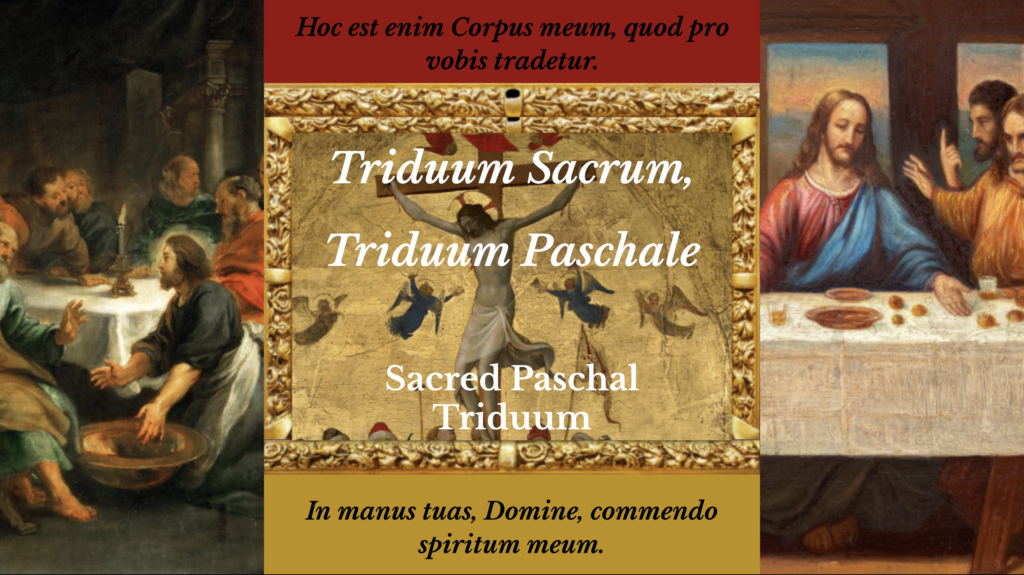
The three-day liturgical celebration of the Paschal Mystery (Passion, Death, and Resurrection of Jesus Christ) begins with the evening Mass of the Lord’s Supper on Holy Thursday. It concludes with evening prayer on Easter Sunday.
Name in Traditional Liturgy: Triduum Sacrum (the Sacred Triduum) or Triduum Paschale
Season Preceding Sacred Paschal Triduum: Lent
Commences: Evening Mass of the Lord’s Supper on Holy Thursday.
Peak: Easter Vigil
Ends: Evening Prayer/Vespers on Easter Sunday
The Catechism and Paschal Triddum:
“Beginning with the Easter Triduum as its source of light, the new age of the Resurrection fills the whole liturgical year with its brilliance. Gradually, on either side of this source, the year is transfigured by the liturgy. It really is a “year of the Lord’s favor.” The economy of salvation is at work within the framework of time, but since its fulfillment in the Passover of Jesus and the outpouring of the Holy Spirit, the culmination of history is anticipated “as a foretaste,” and the kingdom of God enters into our time.
“Therefore Easter is not simply one feast among others, but the “Feast of feasts,” the “Solemnity of solemnities,” just as the Eucharist is the “Sacrament of sacraments” (the Great Sacrament). St. Athanasius calls Easter “the Great Sunday” and the Eastern Churches call Holy Week “the Great Week.” The mystery of the Resurrection, in which Christ crushed death, permeates with its powerful energy our old time, until all is subjected to him.” (CCC #1168, 1169)
Lenten Fasting and Abstinence
Fasting Population: Adults from age 18 until the beginning of their 60th birthday (age 59).
Abstinence Population: Catholics aged 14 and older.
Rule of Abstinence: Refrain from eating meat (beef, pork, chicken, etc.). Fish and dairy products are permitted.
Exempted Population: People with physical or mental illnesses or chronic conditions.
Women who are with child (pregnant) or nursing are excused from these physical fasts and penances.
Code of Canon Law: Days of Penance
Can. 1249 The divine law binds all the Christian faithful to do penance each in his or her own way. In order for all to be united among themselves by some common observance of penance, however, penitential days are prescribed on which the Christian faithful devote themselves in a special way to prayer, perform works of piety and charity, and deny themselves by fulfilling their own obligations more faithfully and especially by observing fast and abstinence, according to the norm of the following canons.
Can. 1250 The penitential days and times in the universal Church are every Friday of the whole year and the season of Lent.
Can. 1251 Abstinence from meat, or from some other food as determined by the Episcopal Conference, is to be observed on all Fridays, unless a solemnity should fall on a Friday. Abstinence and fasting are to be observed on Ash Wednesday and Good Friday.
Can. 1252 The law of abstinence binds those who have completed their fourteenth year. The law of fasting binds those who have attained their majority, until the beginning of their sixtieth year. Pastors of souls and parents are to ensure that even those who by reason of their age are not bound by the law of fasting and abstinence, are taught the true meaning of penance.
Can. 1253 The conference of bishops can determine more precisely the observance of fast and abstinence as well as substitute other forms of penance, especially works of charity and exercises of piety, in whole or in part, for abstinence and fast.
Holy Thursday
The central observance of Holy Thursday is the ritual reenactment of the Last Supper at Mass. Holy Thursday consists of the Chrism Mass, The Mass of the Lord’s Supper, The Washing of the Feet (establishment of the priesthood reenacted at Mass with the priest washing the feet of several parishioners), Transfer of the Eucharist (a solemn liturgical procession where the Blessed Sacrament is moved from the main altar to a temporary place of reservation called the Altar of Repose), the Adoration of the Blessed Sacrament (the faithful remain in the presence of the Eucharist just as the Disciples kept a vigil with Christ), and the Stripping of the Altar (a solemn rite performed after the Mass of the Lord’s Supper on Holy Thursday, where all cloths, candles, and ornaments are removed to leave the altar completely bare representing Jesus being stripped of his garments by soldiers before his crucifixion and mirroring the abandonment by the disciples in Gethsemane and the stark sorrow leading into Good Friday).
Name in Traditional Liturgy: Feria quinta in Cena Domini
Latin Derivative: Feria quinta means “Thursday of the fifth day [of the week],” and in Cena Domini specifically references the Last Supper.
Type of Liturgical Day: Easter Triduum (High Precedence (Tabula dierum liturgicorum secundum ordinem praecedentiae textum, Tabula Praecedentiae, Tabula Dierum Liturgicorum)
Season Preceding Holy Thursday: Lent
Commences: The Evening Mass of the Lord’s Supper
Ends: Dies liturgicus (the liturgical day), Decurrit a media nocte ad mediam noctem (runs from midnight to midnight.
Of Holy Thursday: Chrism Mass, The Foot Washing (Mandatum), Transfer of the Eucharist to the Altar of Repose, Adoration of the Blessed Sacrament, and The Stripping of the Altar (Denudatio Altaris)
The Chrism Mass (Feria Quinta in Cena Domini): Often held earlier in the day at the cathedral, the bishop blesses sacred oils used throughout the year for sacraments.
Mass of the Lord’s Supper: Celebrated in the evening, this service features the symbolic foot-washing ritual performed by the priest.
Altar of Repose (Locus Repositionis): After communion, the remaining consecrated hosts are moved to a temporary altar. The faithful stay late into the night in quiet prayer, mirroring Jesus’ agony in the Garden of Gethsemane.
Office: Psalter Week II
Holy Thursday and the Catechism: 1324 The Eucharist is “the source and summit of the Christian life.” 136 “The other sacraments, and indeed all ecclesiastical ministries and works of the apostolate, are bound up with the Eucharist and are oriented toward it. For in the blessed Eucharist is contained the whole spiritual good of the Church, namely Christ himself, our Pasch.” 137
1337 The Lord, having loved those who were his own, loved them to the end. Knowing that the hour had come to leave this world and return to the Father, in the course of a meal he washed their feet and gave them the commandment of love. 163 In order to leave them a pledge of this love, in order never to depart from his own and to make them sharers in his Passover, he instituted the Eucharist as the memorial of his death and Resurrection, and commanded his apostles to celebrate it until his return; “thereby he constituted them priests of the New Testament.” 164
1340 By celebrating the Last Supper with his apostles in the course of the Passover meal, Jesus gave the Jewish Passover its definitive meaning. Jesus’ passing over to his father by his death and Resurrection, the new Passover, is anticipated in the Supper and celebrated in the Eucharist, which fulfills the Jewish Passover and anticipates the final Passover of the Church in the glory of the kingdom.
1566 “It is in the Eucharistic cult or in the Eucharistic assembly of the faithful (synaxis) that they exercise in a supreme degree their sacred office; there, acting in the person of Christ and proclaiming his mystery, they unite the votive offerings of the faithful to the sacrifice of Christ their head, and in the sacrifice of the Mass they make present again and apply, until the coming of the Lord, the unique sacrifice of the New Testament, that namely of Christ offering himself once for all a spotless victim to the Father.” 49 From this unique sacrifice their whole priestly ministry draws its strength. 50
1356 If from the beginning Christians have celebrated the Eucharist and in a form whose substance has not changed despite the great diversity of times and liturgies, it is because we know ourselves to be bound by the command the Lord gave on the eve of his Passion: “Do this in remembrance of me.” 183
1168 Beginning with the Easter Triduum as its source of light, the new age of the Resurrection fills the whole liturgical year with its brilliance. Gradually, on either side of this source, the year is transfigured by the liturgy. It really is a “year of the Lord’s favor.” 42 The economy of salvation is at work within the framework of time, but since its fulfillment in the Passover of Jesus and the outpouring of the Holy Spirit, the culmination of history is anticipated “as a foretaste,” and the kingdom of God enters into our time.
Good Friday
The most solemn day of the year that marks the passion, crucifixion, and death of Jesus Christ on the cross. It is called “good” because Jesus made a holy sacrifice that saved humanity and opened the gates of heaven, turning a day of suffering into an ultimate victory. Altars are left completely bare, church bells remain silent, and the church maintains a muted, somber tone. The Celebration of the Lord’s Passion takes the place of Mass and consists of three distinct parts: the Liturgy of the Word (including the reading of the Passion according to John), the Veneration of the Cross, and Holy Communion using hosts consecrated on Holy Thursday.
Name in Traditional Liturgy: Feria sexta in Parasceve (or Feria sexta in Passione et Morte Domini)
Latin Derivative: Feria sexta in Parasceve (Parasceve comes from the Greek word for preparation).
Season Preceding Good Friday: Lent
Commences: The second day of the Paschal Triduum, marking the solemn commemoration of the crucifixion and death of Jesus Christ.
Ends: Ends at the beginning of the evening prayer of Holy Saturday. The Good Friday fast officially ends at midnight or is traditionally encouraged to continue through the Easter Vigil as the Paschal fast.
Color: Red
Mass: No Mass is celebrated. The Church holds a Celebration of the Lord’s Passion. This includes the Liturgy of the Word, Solemn Intercessions, Veneration of the Cross. Altars are left completely bare, church bells remain silent, and the church maintains a muted, somber tone. If Holy Communion is given, it is done with Hosts that were consecrated previously at the Mass of the Lord’s Supper on Maundy Thursday.
Office: Psalm 2, Psalm 22, and Psalm 54 (or portions of them), which focus heavily on the Messiah’s suffering, betrayal, and trust in God. Daytime prayer uses the psalms assigned for Friday of Psalter Week II (with specific Lenten/passion antiphons and readings).
Of Good Friday: Celebration of the Lord’s Passion, Liturgy of the Word, Solemn Intercessions, and Veneration of the Cross.
The Celebration of the Lord’s Passion: The Liturgy of the Word: Begins in complete silence as ministers prostrate themselves on the floor, followed by Scripture readings and the reading of the Passion narrative from the Gospel of John.
Solemn Intercessions: The Roman Catholic Good Friday liturgy contains ten distinct universal solemn intercessions that formally conclude the Liturgy of the Word.
For the Holy Church
For the Pope
For all orders and degrees of the faithful
For catechumens
For the unity of Christians
For the Jewish people
For those who do not believe in Christ
For those who do not believe in God
For those in public office
For those in tribulation
Veneration of the Cross: A cross is brought into the church and uncovered in three stages. As it is uncovered, the priest or deacon sings, “Behold the wood of the Cross, on which hung the savior of the world,” and the congregation responds, “Come, let us adore.” The clergy, servers, and congregation line up to approach the cross. Catholics show reverence by kneeling, genuflecting (bending one knee), making a profound bow, touching the wood, or kissing the cross. The custom started in Jerusalem in the fourth century after the reported discovery of the True Cross by Saint Helena.
Good Friday and the Catechism:
621 Jesus freely offered himself for our salvation. Beforehand, during the Last Supper, he both symbolized this offering and made it really present: “This is my body which is given for you” (Lk 22:19).
616 It is love “to the end” 446 that confers on Christ’s sacrifice its value as redemption and reparation, as atonement and satisfaction. He knew and loved us all when he offered his life. 447 Now “the love of Christ controls us, because we are convinced that one has died for all; therefore all have died.” 448 No man, not even the holiest, was ever able to take on himself the sins of all men and offer himself as a sacrifice for all. The existence in Christ of the divine person of the Son, who at once surpasses and embraces all human persons, and constitutes himself as the Head of all mankind, makes possible his redemptive sacrifice for all.
620 Our salvation flows from God’s initiative of love for us, because “he loved us and sent his Son to be the expiation for our sins” (I Jn 4:10). “God was in Christ reconciling the world to himself” (2 Cor 5:19).
623 By his loving obedience to the Father, “unto death, even death on a cross” (Phil 2:8), Jesus fulfils the atoning mission (cf. Is 53:10) of the suffering Servant, who will “make many righteous; and he shall bear their iniquities” (Is 53:11; cf. Rom 5:19).
624 “By the grace of God” Jesus tasted death “for every one”. 459 In his plan of salvation, God ordained that his Son should not only “die for our sins” 460 but should also “taste death”, experience the condition of death, the separation of his soul from his body, between the time he expired on the cross and the time he was raised from the dead. The state of the dead Christ is the mystery of the tomb and the descent into hell. It is the mystery of Holy Saturday, when Christ, lying in the tomb, 461 reveals God’s great sabbath rest 462 after the fulfilment 463 of man’s salvation, which brings peace to the whole universe. 464
625 Christ’s stay in the tomb constitutes the real link between his passible state before Easter and his glorious and risen state today. The same person of the “Living One” can say, “I died, and behold I am alive for evermore”: 465
God [the Son] did not impede death from separating his soul from his body according to the necessary order of nature, but has reunited them to one another in the Resurrection, so that he himself might be, in his person, the meeting point for death and life, by arresting in himself the decomposition of nature produced by death and so becoming the source of reunion for the separated parts. 466
The Easter Vigil
Type of Liturgical Day: Solemnity (Sollemnitas)
Name in Traditional Liturgy: Passchalis Vigilia, Vigilia Paschalis, Paschale Solemnitas, or In Vigilia Paschali (The Easter Vigil in the Holy Night).
Commences: Commences after nightfall on Holy Saturday.
Ends: Before dawn and the break of daylight on Easter Sunday.
Color: White and Gold
Mass: Standard Penitential Act Omitted, Creed Omitted, Gospel Candles Omitted, Opening Rites Omitted
Office: No standard weekly psalter is assigned to the Easter Vigil because the celebration itself takes the place of the Office of Readings (Matins) from the Divine Office.
Of Easter Vigil: The Service of Light (Lucernarium), The Liturgy of the Word (Liturgia Verbi), The Liturgy of Baptism (Benedictio Fontis, Liturgia Baptismalis), The Liturgy of the Eucharist (Liturgia eucharistiae, Liturgia eucharistica)
The Service of Light (Lucernarium): The Service of Light (Lucernarium) is the solemn opening part of the Easter Vigil – the blessing of the fire, the lighting of the paschal candle and the entrance into the church, up until the chanting of the Exultet. In a suitable place outside the Church, a “blazing fire” (rogus ardens) is to be prepared so that the people may gather around it and experience the flames dispelling the darkness and lighting up the night. Thus do the beauty of the fire, its warmth and its light, draw the liturgical assembly together. The rubrics, however, acknowledge that when this cannot be done adaptations may be made. The Missale also states that cross and candles are not to be carried in this procession (EV, no. 8). Having reached the fire, the celebrant and faithful sign themselves with the sign of the cross while the priest says: In the name of the Father, and of the Son, and of the Holy Spirit (EV, no. 9). After this new beginning, he greets the people and then gives the instruction (EV, no. 9). As the celebrant blesses the fire, he says the prayer with hands outstretched (EV, no. 10). The Paschal Candle is brought forward. The celebrant cuts a cross into the candle with a stylus. Then he makes the Greek letter Alpha above the cross, the letter Omega below it, and the four numerals of the current year between the arms of the cross, saying the words indicated. After these rites, the priest lights the candle from the new fire and says: May the light of Christ rising in glory / dispel the darkness of our hearts and minds (EV, no. 14). Before the Easter Proclamation, the priest gives his candle to one of the ministers and blesses incense as at the Gospel during Mass. Having asked for and received the blessing, the deacon announces the Easter proclamation from the ambo or at a lectern. This poetic text captures the whole Easter mystery placed within the context of the economy of salvation. In the absence of a deacon the priest himself or another concelebrating priest may announce the Easter proclamation.
The Liturgy of the Word (Liturgia Verbi): Listening to seven readings from the Old Testament, one reading from Saint Paul, and the Easter Gospel. The story of salvation unfolds God’s faithfulness regarding his people.
The Liturgy of Baptism (Benedictio Fontis, Liturgia Baptismalis): The Sacrament of Baptism for adults, or the blessing of the water, followed by the renewal of baptismal promises and the sprinkling with the blessed water.
The Liturgy of the Eucharist (Liturgia eucharistiae, Liturgia eucharistica): If there are newly baptized adults, they may carry the gifts forward during the offertory. The priest may also offer a special message to them and their sponsors, as they prepare to receive Holy Communion for the first time. After Communion, the priest offers a final blessing and a dismissal that includes a final “Alleluia” before the Mass ends.
The Catechism and Easter Vigil: 647 O truly blessed Night, sings the Exsultet of the Easter Vigil, which alone deserved to know the time and the hour when Christ rose from the realm of the dead! 512 But no one was an eyewitness to Christ’s Resurrection and no evangelist describes it. No one can say how it came about physically. Still less was its innermost essence, his passing over to another life, perceptible to the senses. Although the Resurrection was an historical event that could be verified by the sign of the empty tomb and by the reality of the apostles’ encounters with the risen Christ, still it remains at the very heart of the mystery of faith as something that transcends and surpasses history. This is why the risen Christ does not reveal himself to the world, but to his disciples, “to those who came up with him from Galilee to Jerusalem, who are now his witnesses to the people.” 513
1217 In the liturgy of the Easter Vigil, during the blessing of the baptismal water, the Church solemnly commemorates the great events in salvation history that already prefigured the mystery of Baptism:
Father, you give us grace through sacramental signs
which tell us of the wonders of your unseen power. In Baptism we use your gift of water,
which you have made a rich symbol
of the grace you give us in this sacrament. 11
1243 The white garment symbolizes that the person baptized has “put on Christ,” 42 has risen with Christ. The candle, lit from the Easter candle, signifies that Christ has enlightened the neophyte. In him the baptized are “the light of the world.” 43 The newly baptized is now, in the only Son, a child of God entitled to say the prayer of the children of God: “Our Father.”
The Structure of the Sacred Paschal Triduum
Holy Thursday:
Type of Liturgical Day: High Precedence (Tabula Praecedentiae, Tabula Dierum Liturgicorum)
Name in Traditional Liturgy: Feria quinta in Cena Domini
Latin: Feria quinta means “Thursday of the fifth day [of the week],” and in Cena Domini specifically references the Last Supper.
Color: White
Mass: Final Blessing and Formal Dismissal Omitted
Office: Psalter Week II
Ends: Dies liturgicus (the liturgical day), Decurrit a media nocte ad mediam noctem (runs from midnight to midnight.
Chrism Mass (Holy Thursday)
Type of Liturgical Day: High Precedence (Tabula Praecedentiae, Tabula Dierum Liturgicorum)
Name in Traditional Liturgy: In the traditional liturgy of the Roman Rite (prior to the 1955 reform of Holy Week), a separate “Chrism Mass” as an independent standalone mass did not have its own distinct proper name; instead, the blessing of the oils took place during the morning Mass of Holy Thursday, known in Latin as Feria Quinta in Cena Domini (“Thursday of the Supper of the Lord”).
Color: White
Mass: Gloria, Renewal of Commitment to Priestly Service, Creed & Intercessions Omitted, Blessing of Oils & Consecration of the Chrism, Preface of the Priesthood (Chrism Mass)
Commences: Morning of Holy Thursday
Ends: Dies liturgicus (the liturgical day), Decurrit a media nocte ad mediam noctem (runs from midnight to midnight.
The Foot Washing (Holy Thursday)
Type of Liturgical Day: High Precedence (Tabula Praecedentiae, Tabula Dierum Liturgicorum)
Name in Traditional Liturgy: Mandatum (Pedilavium)
Latin: From the Latin antiphon sung during the ceremony, “Mandatum novum do vobis” (“A new commandment I give unto you”), which quotes Jesus’s words in John 13:34 after he washed his disciples’ feet.
Color: White
Mass: Final Blessing and Formal Dismissal Omitted
Office: Psalter Week II
Ends: Dies liturgicus (the liturgical day), Decurrit a media nocte ad mediam noctem (runs from midnight to midnight.
Transfer of the Eucharist to the Altar of Repose and Adoration of the Blessed Sacrament
Type of Liturgical Day: High Precedence (Tabula Praecedentiae, Tabula Dierum Liturgicorum)
Name in Traditional Liturgy: Locus Repositionis (The Repository)
Latin: The specific enclosure or decorated space on that altar where the ciborium containing the Eucharist is placed.
Color: White
Mass: Final Blessing and Formal Dismissal Omitted
Office: Psalter Week II
Ends: Dies liturgicus (the liturgical day), Decurrit a media nocte ad mediam noctem (runs from midnight to midnight.
The Stripping of the Altar (Holy Thursday)
Type of Liturgical Day: High Precedence (Tabula Praecedentiae, Tabula Dierum Liturgicorum)
Name in Traditional Liturgy: Denudatio Altaris
Latin: It translates literally to the “stripping of the altar.”
The Act: After the Mass of the Lord’s Supper, all altar cloths, linens, and ornaments are removed. This represents Christ being stripped of His garments by the Roman soldiers before His crucifixion. Traditionally, Psalm 22 (Deus, Deus meus) is chanted or recited during the ceremony
Commences: Conclusion of Holy Thursday
Ends: The altar remains bare throughout Good Friday and Holy Saturday until the Easter Vigil begins.
Good Friday
Type of Liturgical Day: Solemnity (Sollemnitas)
Name in Traditional Liturgy: Feria sexta in Parasceve, Feria sexta in Passione Domini (or Feria sexta in Passione et Morte Domini) (or Feria sexta in Passione et Morte Domini)
Latin: Feria sexta in Parasceve (Parasceve comes from the Greek word for preparation).
Color: Red
Mass: No Mass is celebrated. The Church holds a Celebration of the Lord’s Passion. This includes the Liturgy of the Word, Solemn Intercessions, Veneration of the Cross. Altars are left completely bare, church bells remain silent, and the church maintains a muted, somber tone. If Holy Communion is given, it is done with Hosts that were consecrated previously at the Mass of the Lord’s Supper on Maundy Thursday.
Commences: The second day of the Paschal Triduum, marking the solemn commemoration of the crucifixion and death of Jesus Christ.
Office: Psalm 2, Psalm 22, and Psalm 54 (or portions of them), which focus heavily on the Messiah’s suffering, betrayal, and trust in God. Daytime prayer uses the psalms assigned for Friday of Psalter Week II (with specific Lenten/passion antiphons and readings).
Ends: Good Friday ends at the beginning of the evening prayer of Holy Saturday. The Good Friday fast officially ends at midnight or is traditionally encouraged to continue through the Easter Vigil as the Paschal fast.
Easter Vigil
Type of Liturgical Day: Solemnity (Sollemnitas)
Name in Traditional Liturgy: Passchalis Vigilia, Vigilia Paschalis, Paschale Solemnitas, or In Vigilia Paschali (The Easter Vigil in the Holy Night).
Latin: The literal Latin translation for the Paschal or Easter Vigil.
Color: White and Gold
Mass: Standard Penitential Act Omitted, Creed Omitted, Gospel Candles Omitted, Opening Rites Omitted
Office: No standard weekly psalter is assigned to the Easter Vigil because the celebration itself takes the place of the Office of Readings (Matins) from the Divine Office.
Commences: Commences after nightfall on Holy Saturday.
Ends: Before dawn and the break of daylight on Easter Sunday.
The Service of Light (Lucernarium) (Easter Vigil)
Name in Traditional Liturgy: Lucernarium
Latin: The word comes from the Latin lucerna, meaning lamp or oil candle.
Color: White (or Gold)
Mass: Standard Penitential Act Omitted, Creed Omitted, Gospel Candles Omitted, Opening Rites Omitted
Office: No standard weekly psalter is assigned to the Easter Vigil because the celebration itself takes the place of the Office of Readings (Matins) from the Divine Office.
Commences: Commences after nightfall on Holy Saturday.
Ends: Ends immediately after the singing or chanting of the Exsultet (the Easter Proclamation), right before the beginning of the Liturgy of the Word
The Liturgy of the Word (Easter Vigil)
Type of Liturgical Day: Solemnity (Sollemnitas)
Name in Traditional Liturgy: Liturgia Verb
Latin: The phrase combines liturgia (from the Greek leitourgia, meaning a public service or work on behalf of the people) and verbi (the genitive form of verbum, meaning “of the word”).
Color: White (or Gold)
Mass: Standard Penitential Act Omitted, Creed Omitted, Gospel Candles Omitted, Opening Rites Omitted
Office: No standard weekly psalter is assigned to the Easter Vigil because the celebration itself takes the place of the Office of Readings (Matins) from the Divine Office.
Commences: Commences after nightfall on Holy Saturday immediately following the Service of Light (Lucernarium)
Ends: Ends after the Gospel Reading and Homily before the Liturgy of Baptism begins.
The Liturgy of Baptism (Easter Vigil)
Type of Liturgical Day: Solemnity (Sollemnitas)
Name in Traditional Liturgy: Benedictio Fontis or Liturgia Baptismalis.
Latin: Benedictio Fontis: The solemn blessing and consecration of the baptismal water during the Easter Vigil. Liturgia Baptismalis: The formal heading for the baptismal portion of the Vigil service in the Roman Missal.
Color: White (or Gold)
Mass: Standard Penitential Act Omitted, Creed Omitted, Gospel Candles Omitted, Opening Rites Omitted
Office: No standard weekly psalter is assigned to the Easter Vigil because the celebration itself takes the place of the Office of Readings (Matins) from the Divine Office.
Commences: Commences after nightfall on Holy Saturday and after the Liturgy of the Word.
Ends: Concludes with the Renewal of Baptismal Promises and the universal prayer (or universal intercessions/prayer of the faithful) that follows it.
The Liturgy of the Eucharist (Easter Vigil)
Type of Liturgical Day: Solemnity (Sollemnitas)
Name in Traditional Liturgy: Liturgia eucharistiae, Liturgia eucharistica
Latin: The Latin translates to “Liturgy of the Eucharist.”
Color: White (or Gold)
Mass: Standard Penitential Act Omitted, Creed Omitted, Gospel Candles Omitted, Opening Rites Omitted
Office: No standard weekly psalter is assigned to the Easter Vigil because the celebration itself takes the place of the Office of Readings (Matins) from the Divine Office.
Commences: Commences as the fourth and final part of the Easter Vigil, immediately following the Liturgy of Baptism (or the renewal of baptismal promises if there are no baptisms)
Ends: Ends before the Concluding Rite which includes the final blessing and solemn double Alleluia dismissal.
Liturgical Colors of the Sacred Paschal Triduum
Holy Thursday (Mass of the Lord’s Supper): White or Gold is used to celebrate the institution of the Eucharist and the Priesthood, symbolizing joy, light, and the glory of Christ.
Good Friday (Celebration of the Passion of the Lord): Red is used to signify Christ’s blood shed on the cross and His passion.
Holy Saturday / Easter Vigil: White or Gold returns at the Easter Vigil during the night to celebrate the glorious resurrection of Jesus
Google Images was used to collect the photographs on this page. The photographs do not belong to Global Catholic Resource Center©.

Share