
The information here may change before this webpage can be updated. Please consult your parish priest or other trusted resources to ensure the information is current.
Christmas
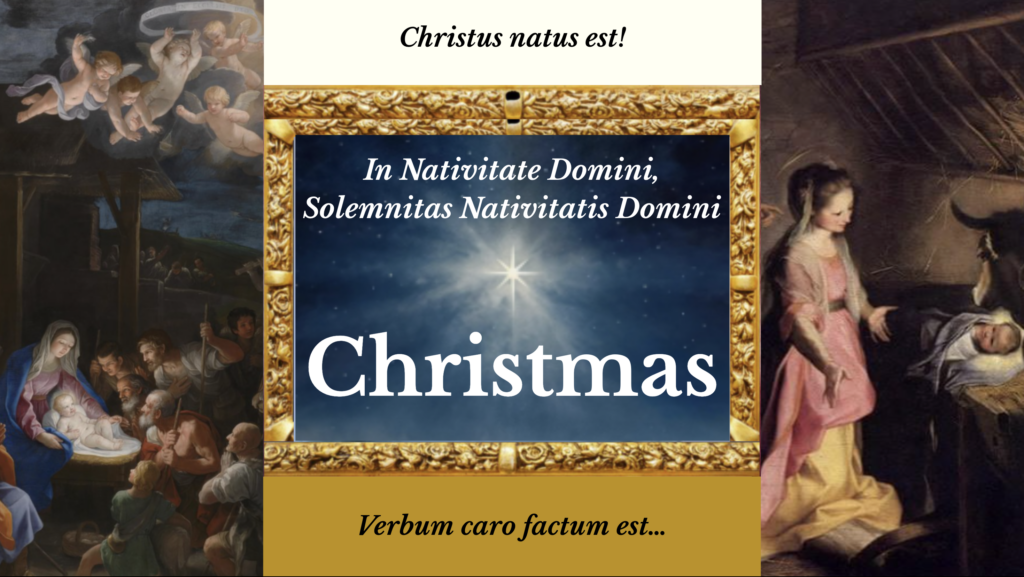
Christmas is the celebration of the Incarnation—the moment when God entered human history by becoming man in Jesus Christ. The word for Christmas in late O. E. is Cristes Maesse, the Mass of Christ, first found in 1038, and Cristes-messe, in 1131.
Name in Traditional Liturgy: In Nativitate Domini or Solemnitas Nativitatis Domini (Solemnity of the Nativity of the Lord)
Commences: Eve of 24 December
Final Days: The final days leading up to this conclusion include Epiphany and the compressed days of early January.
Ends: The official liturgical Christmas season concludes with the Feast of the Baptism of the Lord (usually the Sunday after Epiphany in early January), though traditional and historical calendars extend the final days all the way to Candlemas (Presentation of the Lord) on February 2nd.
The Catechism and Christmas: In the Nativity of our Lord, within the context of the humble poverty He undertook, heaven’s glory is made manifest (Catechism of the Catholic Church 525). At the heart of the mystery resides the “marvelous exchange” where the “Creator has become man, born of the Virgin,” and we “have been made sharers in the divinity of Christ who humbled Himself to share our humanity” (CCC 526).
The mystery that is Christmas speaks to the purposes of the Incarnation, most notably Christ enabling us to partake in His divine nature (CCC 460). Of course, this is inseparable from Him showing us the extent of God’s love (CCC 458), for in this “the love of God was made manifest among us, that God sent His only Son into the world, so that we might live through Him” (1 John 4:9).
525 Jesus was born in a humble stable, into a poor family. 202 Simple shepherds were the first witnesses to this event. In this poverty heaven’s glory was made manifest. 203 The Church never tires of singing the glory of this night:
The Virgin today brings into the world the Eternal
And the earth offers a cave to the Inaccessible.
The angels and shepherds praise him
And the magi advance with the star,
For you are born for us, Little Child, God eternal! 204
526 To become a child in relation to God is the condition for entering the kingdom. 205 For this, we must humble ourselves and become little. Even more: to become “children of God” we must be “born from above” or “born of God”. 206 Only when Christ is formed in us will the mystery of Christmas be fulfilled in us. 207 Christmas is the mystery of this “marvellous exchange”: O marvellous exchange! Man’s Creator has become man, born of the Virgin. We have been made sharers in the divinity of Christ who humbled himself to share our humanity. 208
Advent
Advent (from “ad-venire” in Latin, meaning “to come to”) means “coming” or “arrival” and is the season encompassing the four Sundays (and weekdays) leading up to the celebration of Christmas (25 December).
Name in Traditional Liturgy: Tempus Adventus (the Season of Advent)
Liturgical Colors: Purple (Violet), Rose (Pink)
Season Preceding Advent: Ordinary Time
Commences: Four Sundays Before Christmas
Final Days: The final days of Advent, from December 17 to December 24, focus particularly on our preparation for the celebrations of the Nativity of our Lord (Christmas).
Ends: 24 December
The Catechism and Advent: The Catechism of the Catholic Church stresses the two-fold meaning of this coming: “When the Church celebrates the liturgy of Advent each year, she makes present this ancient expectancy of the Messiah, for by sharing in the long preparation for the Savior’s first coming, the faithful renew their ardent desire for His second coming” (No. 524).
Ancient Expectancy (CCC 524): Reliving the long historical wait for the Savior’s birth in Bethlehem.
Second Coming (CCC 522): Renewing the deep hope and readiness for Christ’s return at the end of time.
Preparation of History (CCC 522-523): Remembering how God prepared all of human history and sent John the Baptist to make ready the way for Jesus.
Christmas Day
Celebrates the birth of Jesus Christ on December 25.
Name in Traditional Latin: Dies Natalis Domini: “Birthday of the Lord”
Festum Nativitatis Domini Nostri Jesu Christi: “Feast of the Nativity of Our Lord Jesus Christ”).
Liturgical Colors: The liturgical color for Christmas Day in the Catholic Church is white. White symbolizes purity, joy, and the glory of Christ’s birth.
Season Preceding Christmas Day: Advent
Commences: Eve of 24 December
Ends: Midnight of 25 December
Office: On December 25 (the Solemnity of the Nativity of the Lord / Christmas Day), the regular four-week psalter cycle of the Liturgy of the Hours is replaced. Instead, a Proper of the Season is used, featuring specific psalms and antiphons chosen explicitly to celebrate the mystery of Christ’s birth rather than the standard weekday or Sunday psalter week.
Christmas Day in the Catechism: 525 Jesus was born in a humble stable, into a poor family. 202 Simple shepherds were the first witnesses to this event. In this poverty heaven’s glory was made manifest. 203 The Church never tires of singing the glory of this night:
The Virgin today brings into the world the Eternal
And the earth offers a cave to the Inaccessible.
The angels and shepherds praise him
And the magi advance with the star,
For you are born for us, Little Child, God eternal! 204
526 To become a child in relation to God is the condition for entering the kingdom. 205 For this, we must humble ourselves and become little. Even more: to become “children of God” we must be “born from above” or “born of God”. 206 Only when Christ is formed in us will the mystery of Christmas be fulfilled in us. 207 Christmas is the mystery of this “marvellous exchange”:
O marvellous exchange! Man’s Creator has become man, born of the Virgin. We have been made sharers in the divinity of Christ who humbled himself to share our humanity. 208
Octave of Christmas
An octave is the eight-day period the Church recognizes after both Christmas and Easter. The Octave of Christmas concludes with the Solemnity of the Blessed Virgin Mary on January 1. During the octave, every day is celebrated as a solemnity of Christmas.
Name in Traditional Latin: Octava Nativitatis Domini: The Octave of the Nativity of the Lord
Dies Octava Nativitatis Domini or In Octava Nativitatis Domini: “On the Eighth Day of the Nativity of the Lord”
Liturgical Colors: During these eight days of Christmas, clergy wear white during the Mass. Red is worn on December 26 (the Feast of St. Stephen) and December 28 (the Feast of the Holy Innocents). Red signifies their martyrdom, as both saints shed their blood for Christ.
Season Preceding the Octave of Christmas: Advent
Commences: 25 December
Final Days: In the Catholic Church, the final days of the Octave of Christmas occur from December 29 to January 1, culminating on New Year’s Day with the Solemnity of Mary, the Holy Mother of God.
Ends: 1 January
Office: During the octave of Christmas in the modern Roman Rite (Liturgy of the Hours), the psalter for the weekdays within the octave uses Psalter Week I.
Christmastide or Christmas Season:
Continues past the New Year through early January.
Name in Traditional Latin: tempus Nativitatis (The Season of the Nativity)
Liturgical Colors: White (gold may be used as an alternative). White symbolizes purity, joy, and the glory of Christ’s birth. Red is worn on December 26 (the Feast of St. Stephen) and December 28 (the Feast of the Holy Innocents). Red signifies their martyrdom, as both saints shed their blood for Christ.
Season Preceding Christmastide or Christmas Season: Advent
Commences: Eve of December 24
Final Days: The final days of Christmastide are the brief period immediately following the Feast of the Epiphany up to the Feast of the Baptism of the Lord. This transition takes place during the first week of January, leading directly into Ordinary Time.
Ends: Feast of the Baptism of the Lord, which is celebrated on the Sunday after Epiphany (usually falling in early January).
The Feast of the Holy Family
Celebrates Jesus, Mary, and Joseph, usually the Sunday after Christmas.
Name in Traditional Latin: Festum Sanctae Familiae (Common Title) or Festum Sanctae Familiae Jesu, Mariae, Joseph (Full Title)
Day Celebrated: The Feast of the Holy Family is celebrated on the Sunday between Christmas Day and New Year’s Day. If Christmas falls on a Sunday, the feast is moved to December 30.
Liturgical Color: White
Office: During the Feast of the Holy Family (celebrated within the Octave of Christmas), the Liturgy of the Hours follows the Psalter for Sunday, Week I (or the specific proper antiphons and complementary psalmody assigned for the feast within the Proper of Seasons). Because the feast typically falls on a Sunday during the Christmas octave, it utilizes Week I of the four-week psalter cycle.
Catechism of the Catholic Church: Jesus’ daily submission to Mary and Joseph perfectly honored the fourth commandment and foreshadowed his ultimate obedience to the Heavenly Father on Holy Thursday (CCC 532).
Christ’s routine obedience in the Holy Family began the work of repairing the damage caused by Adam’s disobedience (CCC 532).
1655 Christ chose to be born and grow up in the bosom of the holy family of Joseph and Mary. The Church is nothing other than “the family of God.” From the beginning, the core of the Church was often constituted by those who had become believers “together with all [their] household.” 166 When they were converted, they desired that “their whole household” should also be saved. 167 These families who became believers were islands of Christian life in an unbelieving world.
Structure of Christmas and Christmastide
The Nativity of the Lord (25 December)
Type of Liturgical Day: Solemnity (Sollemnitas)
Name in Traditional Liturgy: In Nativitate Domini (The Nativity of the Lord)
Colors: White
Mass: The Christmas Proclamation (The Calends), Proper Communicantes, Genuflection during the Creed
Office: Proper Psalms (i.e., Psalm 63, Psalm 149, Psalm 110, Psalm 132)
Commences: 24 December (Sunset Vigil Mass)
Ends: The Octave (Dec. 25 – Jan. 1) ends on January 1 with the Solemnity of Mary, the Holy Mother of God.
Feast of Saint Stephen (26 December)
Type of Liturgical Day: Feast (Festum)
Name in Traditional Liturgy: Sancti Stephani Protomartyris
Colors: Red
Mass: Proper Antiphon, Preface of the Nativity, Communicantes with Eucharistic Prayer
Office: Sunday, Week I of the Four-Week Psalter
Commences: 26 December
Ends: 26 December (End)
Feast of Saint John the Apostle (27 December)
Type of Liturgical Day: Feast (Festum)
Name in Traditional Liturgy: Sancti Ioannis Apostoli et Evangelistae or In festo Sancti Ioannis Apostoli et Evangelistae
Colors: White
Mass: Proper Prayers and Antiphons, Proper Readings (i.e., 1 John 1:1–4, John 20:1a, 2–8)
Office: Special Psalmody
Commences: 27 December (Celebrated two days after Christmas, during the Christmas season (Christmastide).
Ends: 27 December (Midnight)
Feast of the Holy Innocents (28 December)
Type of Liturgical Day: Feast (Festum)
Name in Traditional Liturgy: Festum Sanctorum Innocentium Martyrum
Colors: Red
Office: Sunday, Week I of the Four-Week Psalter
Commences: 28 December
Ends: 28 December (Midnight)
Feast of the Holy Family
Type of Liturgical Day: Feast (Festum)
Name in Traditional Liturgy: Festum Sanctae Familiae or Festum Sanctae Familiae Iesu, Mariae et Ioseph
Colors: White
Office: Sunday, Week I of the Four-Week Psalter
Commences: The fourth day in the octave (eight-day period) of Christmas.
Ends: The fourth day in the octave (eight-day period) of Christmas (midnight).
Solemnity of Mary, the Mother of God (1 January)
Type of Liturgical Day: Solemnity (Sollemnitas)
Name in Traditional Liturgy: Sollemnitas Sanctae Dei Genetricis Mariae, In octava Nativitatis Domini: Sollemnitas Sanctae Dei Genetricis Mariae)
Colors: White (or Gold)
Mass: Gloria and Nicene Creed Added
Office: Week I of the Four-Week Psalter
Commences: 1 January
Ends: 1 January (Midnight)
The Epiphany of the Lord
Type of Liturgical Day: Solemnity (Sollemnitas)
Name in Traditional Liturgy: Epiphania Domini or In Epiphania Domini
Colors: White (or Gold)
Office: Proper psalms (Pss. Prop.)
Commences: 6 January or First Sunday after 1 January
Ends: Depends upon Date Celebrated
Baptism of the Lord (Sunday after the Epiphany)
Type of Liturgical Day: Feast (Festum)
Name in Traditional Liturgy: Festum Baptismatis Domini
Colors: White (or Gold)
Mass: Proper Prayers, Preface of the Baptism of the Lord, The Lectionary provides specific readings focused on the baptism of Jesus and the descent of the Holy Spirit (from Isaiah, Acts/Titus, and the Gospels of Matthew, Mark, or Luke depending on the liturgical year), Gloria and Creed Recited
Office: Week I of the Four-Week Psalter
Commences: If the Epiphany is transferred to Sunday, January 7 or January 8 (in regions where January 6 is not a holy day of obligation), the Baptism of the Lord is instead celebrated on the following Monday.
Ends: Depends upon Date Celebrated
Liturgical Colors of Christmas
White: Light, Innocence, Purity, Joy, Triumph, Glory
White represents joy, innocence, purity and glory. White vestments are worn during the seasons of Easter and Christmas; on all feasts of Our Lord other than his Passion; on feasts of the Blessed Virgin; the angels and those saints who were not martyrs.
Google Images was used to collect the photographs on this page. The photographs do not belong to Global Catholic Resource Center©.

Share